
A breakfast that feels adequate at 7am may leave you searching for something to eat before 10am, particularly when the morning involves commuting, physical work, travel or several hours without a proper break. Making breakfast more substantial does not necessarily mean piling extra food onto the plate.
A more useful starting point is to combine protein, fibre-rich carbohydrates and appropriate portions of fat. Porridge with yoghurt, eggs on wholemeal toast or a carefully assembled yoghurt bowl can all work. What matters is how the ingredients complement each other, how much you eat and what your morning demands.
There is no universal breakfast that guarantees fullness until lunch. Appetite varies with activity, timing, sleep, individual preferences and the rest of your diet. Understanding why some breakfasts leave you hungry sooner makes it easier to adapt familiar foods without turning every morning into a complicated meal-planning exercise.
What makes breakfast filling enough?
- Combine a protein source with fibre-rich foods rather than relying mainly on refined carbohydrates or sweet toppings.
- Improve your usual breakfast before increasing its size: yoghurt, eggs, oats, wholemeal bread and fruit provide practical options.
- Choose larger portions when activity or a long gap before lunch makes them useful, and judge the result by your own hunger patterns.
- Why Can a Small Breakfast Leave You Distracted by Hunger Before Mid-Morning?
- How Can You Make Your Usual Breakfast More Filling Without Doubling the Portion?
- Porridge, Eggs on Toast or Yoghurt Bowl: Which Breakfast Suits a Long Morning Best?
- Which Breakfast Additions Can Make a Filling Meal Unnecessarily Heavy?
- When Should You Choose a Bigger Breakfast Instead of Your Usual Light Option?
- Which Breakfast Mistakes Can Lead to Hunger Before Mid-Morning?
- Eggs, Ricotta or Nut Butter: Which Topping Fits Your Whole-Grain Toast Best?
- Which Meal Combinations Support More Sustained Energy Between Meals?
Why Can a Small Breakfast Leave You Distracted by Hunger Before Mid-Morning?
A small breakfast may leave you hungry early because it provides too little overall food, too little protein or too little fibre to keep you satisfied. A meal consisting mainly of white toast, sweet cereal or a sugary drink may also be less satisfying than one containing a broader mix of nutrients. The effect varies between people.
Carbohydrates are an important energy source, but their type and the foods eaten alongside them matter. Refined carbohydrates generally contain less fibre than their wholegrain equivalents. Some refined carbohydrate foods are digested relatively quickly, while protein, fat and certain types of fibre can influence digestion and appetite.
Blood glucose normally rises after a carbohydrate-containing meal and subsequently falls as the body processes it. However, an early return of hunger does not automatically mean a dramatic blood sugar crash. Appetite involves several overlapping processes, including stomach fullness, digestive hormones, food composition and individual energy needs.
Protein is particularly relevant when building a more satisfying meal. A systematic review of protein intake and appetite, published in 2020, examined randomised controlled trials in healthy adults. Its analysis found that short-term protein intake reduced reported hunger and increased feelings of fullness compared with isocaloric controls. Longer-term findings were inconclusive.
7 mm less hunger
Average reduction on a visual analogue appetite scale following acute protein interventions in the 2020 meta-analysis. This is a research measure of perceived hunger, not a prediction of how long breakfast will last.
Kohanmoo, Faghih and Akhlaghi, Physiology & Behavior, 2020.
Consider two hypothetical breakfasts: a slice of white toast with jam and a cup of tea, versus wholemeal toast with an egg and some tomatoes. The second includes an additional protein source and more fibre-rich ingredients. That makes it a reasonable option to try when the first repeatedly leaves you hungry, although the comparison does not guarantee a particular appetite response.
Before changing breakfast, distinguish physical hunger from other morning cues. An empty or rumbling stomach, increasing interest in food and difficulty feeling satisfied can indicate hunger. By contrast, reaching for a snack during a repetitive task may reflect habit, boredom or an established break routine. Thirst can also be worth considering, but drinking water is not a substitute for food when genuine hunger is present.
Ask yourself whether you would welcome an ordinary, balanced snack rather than only a particular treat. This is an informal self-check, not a diagnostic test. If you regularly feel hungry soon after a small breakfast, its composition or quantity is worth reviewing.
The distinction is useful: a breakfast can be light in calories, limited in satisfying nutrients or both. Once you identify the likely problem, improving the ingredients may be enough without substantially increasing the portion.
How Can You Make Your Usual Breakfast More Filling Without Doubling the Portion?
Make your usual breakfast more filling by keeping its familiar base and improving the balance of protein, fibre and other ingredients. Add yoghurt to cereal, choose wholemeal bread instead of white toast or include oats in a smoothie. Where appropriate, reduce a less satisfying ingredient to make room, rather than simply enlarging the meal.
This upgrade rather than upsize approach works because eating more of the same food is not always the most useful adjustment. A larger serving of sweet cereal, for example, may increase the amount eaten without addressing a breakfast that contains little protein.
For an ordinary UK-style breakfast, practical changes include:
- Toast: replace white bread with wholemeal or granary bread, then add an egg, ricotta or a modest amount of nut butter.
- Cereal: choose an unsweetened wholegrain variety and include plain Greek yoghurt or another suitable protein-containing food.
- Porridge: prepare oats with milk or a suitable alternative, then add yoghurt and fruit rather than relying on sugar or syrup.
- Fruit: pair an apple, banana or berries with yoghurt or nuts when fruit alone does not satisfy you.
These changes reflect the food-quality principles in the NHS Eatwell Guide, which recommends higher-fibre starchy foods, varied protein sources and moderate amounts of unsaturated fats. The guide also makes clear that dietary balance can be achieved across a day or week rather than at every individual meal.
Fibre adds another dimension. Wholegrain bread, oats and fruit with edible skin contribute fibre, although different fibre sources do not necessarily produce identical effects on appetite. Adding seeds can contribute nutrients and texture, but their presence alone does not guarantee a more satisfying breakfast.
Liquid breakfasts deserve particular attention. Juice may be easy to drink alongside breakfast, but it offers a different combination of fibre, protein and physical texture from a bowl of oats or yoghurt. Smoothies vary considerably: one made mainly from juice is quite different from one containing thick yoghurt, oats and whole fruit.
The practical solution is to assess what the drink contains. A smoothie with yoghurt and oats may be a more complete breakfast than juice alone, while someone who still feels hungry after drinking it may prefer to eat some ingredients separately. There is no fixed rule that liquids always produce less satiety than solid meals.

Portion adjustment completes the method. Suppose your usual bowl contains a generous amount of cereal with just a little milk. You could try slightly less cereal and more plain yoghurt, adding fruit for variety. This changes the composition without necessarily increasing the total amount of food very much.
Another hypothetical example is swapping some sweet granola for oats and yoghurt. The goal is not to eliminate enjoyable ingredients, but to give more space to foods that contribute protein and fibre.
Keep the adjustment manageable. Changing one element at a time makes it easier to notice which combinations suit your appetite, schedule and preferences.
Once the basic combination is more balanced, the next decision is which breakfast format fits the time available and the demands of your morning.
Porridge, Eggs on Toast or Yoghurt Bowl: Which Breakfast Suits a Long Morning Best?
Porridge, eggs on toast and yoghurt bowls can all support a long morning when they include an appropriate balance of nutrients. Porridge offers a convenient oat-based foundation, eggs on toast provide a straightforward protein-containing meal, and yoghurt bowls are quick to assemble. The best choice depends on preparation time, appetite, activity and portion size.
None of these options has a scientifically established advantage for keeping every person full for a specific number of hours. Their practical strengths differ, and the complete meal matters more than its name.
The following comparison is a decision aid rather than a measured ranking of satiety.
| Criterion | Porridge | Eggs on toast | Yoghurt bowl |
|---|---|---|---|
| Main strength | Oats provide a fibre-containing carbohydrate base. | Eggs make protein a prominent part of the meal. | Easy preparation with flexible protein and fruit additions. |
| Preparation | Requires cooking or advance preparation. | Usually involves cooking eggs and preparing toast. | Can be assembled without cooking. |
| Useful situation | A long desk-based morning or a routine requiring a prepared meal. | A morning when a savoury, protein-containing meal is appealing. | An early departure or a morning with limited preparation time. |
| Potential weakness | A small bowl made mainly with water may contain relatively little protein. | White toast and minimal accompaniments may contribute little fibre. | Sweetened yoghurt with large amounts of granola may contain considerable added sugar. |
| Practical improvement | Add milk, plain yoghurt, fruit or a suitable protein-containing accompaniment. | Use wholemeal toast and include vegetables. | Choose protein-rich plain yoghurt, fruit and a modest portion of oats or seeds. |
Porridge is a flexible choice for a long morning because oats provide a useful carbohydrate foundation and can be combined with protein-containing ingredients. A 2026 systematic review of 48 studies examined cereal fibre and appetite. It found generally favourable effects on reported satiety, with comparatively stronger findings for oat and rye fibre than for several other sources.
The 2026 systematic review on cereal fibre and satiety also identified an important limitation: greater perceived fullness did not consistently translate into reduced food consumption later. It therefore supports considering oat fibre as part of a satisfying meal, not promising that porridge will prevent hunger until a particular time.
Eggs on wholemeal toast may suit someone who prefers a savoury breakfast or wants an obvious protein source. However, one egg on a small slice of toast might still be insufficient before several hours of physical work. Adding vegetables, another suitable accompaniment or an appropriately larger portion can make the meal better suited to the day.
Plain Greek yoghurt offers a convenient base for a bowl containing berries, oats or other wholegrain cereal. This is particularly useful when cooking is impractical. However, yoghurt products differ in protein and sugar content, so checking the label is more reliable than assuming every yoghurt bowl has the same nutritional properties.
For a particularly long morning, combining elements may be more practical than selecting one category. Porridge with yoghurt, eggs with wholemeal toast and fruit, or a yoghurt bowl with oats and nuts can each provide a broader mix of foods.
The total quantity should reflect your circumstances. Someone preparing for manual work may need more food than someone spending a short morning at a desk, even when both choose the same breakfast.
Whatever the choice, more toppings and richer ingredients are not automatically better. The next challenge is keeping the breakfast satisfying without making it uncomfortable or unnecessarily heavy.
Which Breakfast Additions Can Make a Filling Meal Unnecessarily Heavy?
Large amounts of cheese, butter, fried foods, sugary spreads, granola or nut butter can make breakfast substantially richer without necessarily improving satisfaction in proportion to the extra food. These ingredients are not automatically unsuitable, but excessive portions may leave you feeling uncomfortable, especially before physical activity. Aim for a satisfying combination rather than maximum fullness.
There is an important distinction between a breakfast that contains enough energy for the morning and one that simply accumulates energy-dense extras. Protein-rich foods, fibre-containing ingredients and fruit or vegetables contribute different nutritional benefits. Added sugars and oils can increase energy intake without necessarily addressing what made the original meal unsatisfying.
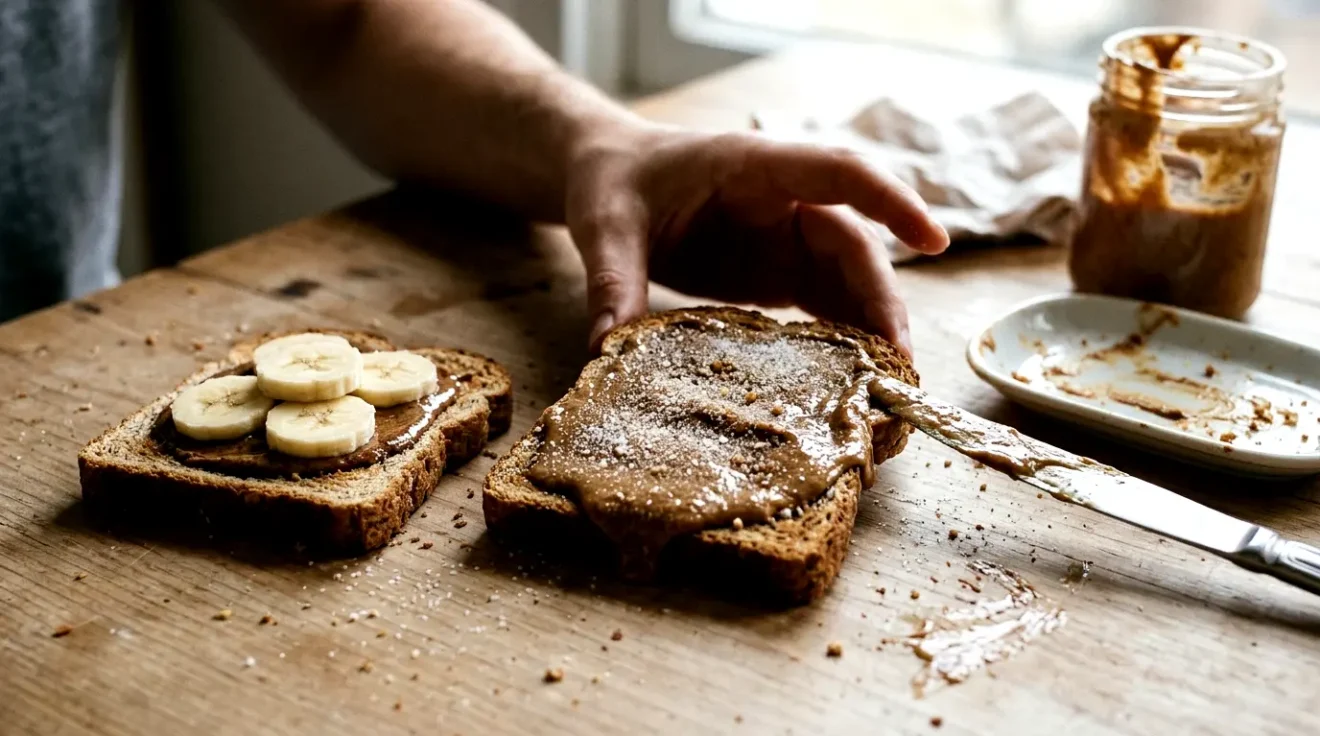
Fat is an important part of a balanced diet, and foods such as nuts and nut butter can fit into a nutritious breakfast. However, fats are energy-dense, so the quantity matters. A spoonful of nut butter can complement wholemeal toast, whereas a very thick layer may turn a modest breakfast into a much richer meal than intended.
Granola presents a similar challenge. It may contain oats, nuts and seeds, but some products also contain substantial added sugar or fat. A generous portion over sweetened yoghurt, accompanied by honey and chocolate, can look like a balanced bowl while leaving less room for plain yoghurt, fruit or other useful ingredients.
The NHS advice on reducing sugar at breakfast recommends alternatives such as plain porridge, unsweetened wholegrain cereals and wholemeal toast. It also suggests reducing sugary spreads and using fruit to provide sweetness.
The NHS recommends that free sugars account for no more than 5% of daily dietary energy, approximately 30 g daily for people aged 11 and older. This is an overall dietary recommendation, not a breakfast-specific allowance.
Heavy meals can also be inconvenient before an active morning. If a rich breakfast leaves you feeling sluggish or physically uncomfortable, consider adjusting its size, fat content or timing. Experiences differ, and there is no single amount of cheese, oil or nut butter that will cause discomfort for everyone.
As an informal portion check, look at how much space a topping occupies. Is a layer of spread complementing the bread, or has it become the dominant ingredient? Is granola adding crunch, or replacing most of the protein-containing yoghurt? A thin layer or small spoonful can be a useful starting point, but it is not a scientifically established universal threshold.
The most useful addition is one that addresses a genuine gap. If your breakfast contains little protein, another spoonful of jam is unlikely to solve that issue. If it already contains ample protein but little fibre, adding more cheese may be less useful than choosing wholemeal bread or including fruit.
Moderating rich additions does not mean breakfast must always be small. Some mornings genuinely call for a greater quantity of food, particularly when physical demands or meal timing change.
When Should You Choose a Bigger Breakfast Instead of Your Usual Light Option?
A bigger breakfast may be appropriate when you expect substantial physical activity, a long interval before lunch or limited opportunities to eat later. On ordinary mornings, improving the balance of your usual meal may be sufficient. Increasing quantity becomes more useful when a balanced breakfast still leaves you hungry before your next realistic eating opportunity.
Consider the demands of the day rather than relying on a fixed breakfast size. Working at a desk, walking around a large workplace, travelling for several hours and undertaking physically demanding work can involve different energy requirements and eating opportunities.
There are three particularly practical reasons to consider a larger meal:
- Higher physical demands: a morning involving prolonged movement or manual work may justify more food than a relatively sedentary routine.
- A longer gap before lunch: an early breakfast followed by a late lunch may require a larger meal or an additional snack.
- Restricted access to food: travel, shift work or appointments may make it difficult to eat when hunger returns.
These are practical considerations, not evidence that every physically active person must eat a larger breakfast. Individual appetite, exercise timing, overall dietary intake and personal health needs still matter.
For example, imagine two hypothetical Mondays. On the first, you start work at a desk after breakfast and can take a break whenever needed. On the second, you leave early for a long journey followed by several hours of activity, with lunch uncertain. The second schedule may make a larger breakfast or a prepared snack more useful.
The adjustment can be modest. Someone who normally eats one slice of wholemeal toast with an egg might add another slice, fruit or yoghurt. Someone who already eats porridge with milk and fruit may simply increase the portion of oats according to appetite and activity.
Importantly, more food is not the only solution to a longer morning. A planned snack can be preferable to forcing down a very large breakfast when you have little appetite at 6am.
There is also no need to enlarge breakfast automatically simply because it is an early meal. Regularly eating beyond comfortable fullness may make later appetite cues harder to interpret for some people, but a universal rebound effect on appetite regulation has not been established by the sources considered here.
Build a breakfast that fits tomorrow morning
- Write down your breakfast time and expected lunch time. Produce a simple timeline showing the likely interval between meals.
- Identify the morning’s main demands. Note whether you expect desk work, prolonged walking, physical work or limited access to food.
- Record your usual breakfast ingredients. Create a short list identifying its protein source, fibre source and main carbohydrate-containing food.
- Choose one specific adjustment. Write down either an ingredient upgrade, a modest portion increase or a planned snack.
- Check the result the following day. Record when hunger returned and whether the meal felt comfortable, sufficient or unnecessarily heavy.
The checklist turns a general nutrition principle into a decision based on your own circumstances. It is a practical self-observation exercise rather than a clinical nutrition assessment.
Before increasing portions, it is also worth checking whether a common breakfast mistake is creating the hunger problem in the first place.
Which Breakfast Mistakes Can Lead to Hunger Before Mid-Morning?
Common mistakes include relying on coffee or juice instead of food, eating a breakfast dominated by sugary or refined foods, overlooking protein and choosing a portion that does not suit the morning ahead. Eating very early without planning for a late lunch can also leave a long gap. Each issue has a relatively simple adjustment.
One frequent pattern is treating a drink as a complete meal. Coffee, tea and juice can accompany breakfast, but they do not necessarily provide the range of nutrients and energy that someone needs for a long morning. Fruit juice, in particular, is not nutritionally equivalent to a whole balanced meal.
The NHS Eatwell Guide recommends limiting fruit juice and smoothies to a combined total of 150 ml per day. This guidance concerns overall dietary balance and free sugar intake; it does not mean all smoothies are equally formulated or that one particular drink will cause hunger at a predictable time.
Another mistake is building breakfast almost entirely around sweetness. Jam on white toast, a pastry or a bowl of sugary cereal may be enjoyable, but these options can provide limited protein and fibre unless accompanied by other foods.
The practical correction is not necessarily to remove sweet flavours. Plain yoghurt with berries, porridge with banana or wholemeal toast with a modest sweet topping and an additional protein source can retain the foods you enjoy while broadening the meal’s composition.
Protein is easily overlooked in familiar breakfasts. Cereal with a small amount of milk or toast with jam may contain some protein, but the amount depends on the ingredients and serving sizes. Rather than assuming the meal is sufficient, identify whether eggs, yoghurt, milk, nuts or another protein-containing food has a meaningful place in it.
Timing can be just as important as ingredients. Imagine eating breakfast at 6am and not having lunch until early afternoon. Even a balanced meal may not comfortably bridge that interval, particularly during an active morning. Preparing a snack may be more sensible than making breakfast excessively large.
Skipping breakfast is another pattern worth evaluating individually. Some adults prefer eating later and may manage comfortably, while others find that missing their morning meal leaves them distracted or excessively hungry before lunch. Breakfast timing should reflect practical needs and appetite, rather than an assumed rule that everyone must eat immediately after waking.
Finally, avoid the healthy but not filling assumption. A piece of fruit provides useful nutrients, but fruit alone may not constitute a substantial breakfast for someone facing hours of activity. A small smoothie can present the same issue, depending on its ingredients and portion.
The solution is to assess the complete eating occasion. If fruit forms the base, adding yoghurt, oats or another suitable food may turn a light start into a more adequate meal.
Once these underlying problems are addressed, a simple food such as whole-grain toast can become a reliable breakfast base, especially when paired with a topping chosen for a specific nutritional purpose.
Eggs, Ricotta or Nut Butter: Which Topping Fits Your Whole-Grain Toast Best?
Eggs are a useful choice when you want a substantial protein-containing topping, ricotta offers a mild dairy-based option that works with sweet or savoury ingredients, and nut butter provides a convenient source of mostly unsaturated fat along with some protein. The most suitable topping depends on your preferences, portion size and what else accompanies the toast.
Whole-grain toast already contributes carbohydrate and fibre, making it a practical base for different breakfast combinations. The topping changes the meal’s nutritional profile, preparation requirements and overall richness.
Eggs suit a savoury, protein-focused breakfast. One or two eggs can be prepared boiled, poached or scrambled and paired with tomatoes, mushrooms or spinach. This creates a straightforward meal containing protein, a fibre-rich carbohydrate base and vegetables. The amount needed depends on the rest of the meal and individual appetite.
Ricotta provides a softer, milder alternative. It contains dairy protein and can be served with sliced fruit, herbs or vegetables. However, ricotta typically contains less protein per 100 g than many strained Greek yoghurts, and products vary. It should not automatically be treated as nutritionally interchangeable with eggs or higher-protein dairy products.
For a sweet breakfast, ricotta with berries or sliced pear on whole-grain toast can provide a combination of dairy, fruit and bread. For a savoury version, ricotta with tomatoes and herbs creates a different flavour without requiring substantial cooking.
Nut butter prioritises convenience and energy density. Peanut or almond butter can be spread directly onto toast, making it helpful when breakfast preparation time is limited. It contains fat, some protein and other nutrients, but a thin spread is not nutritionally equivalent to an egg-based protein portion.
Pairing nut butter with banana introduces fruit and additional carbohydrate. This may be appealing before an active morning, although the combination’s suitability still depends on how much is eaten and what activity follows.
| Topping | Practical advantage | Useful pairing | Portion consideration |
|---|---|---|---|
| Eggs | Substantial protein source | Tomatoes, spinach or mushrooms | One or two eggs may suit different appetites and meal combinations. |
| Ricotta | Versatile dairy topping | Berries, pear, tomatoes or herbs | Choose a serving that contributes meaningfully to the meal without overwhelming the bread. |
| Nut butter | Minimal preparation and energy-dense fats | Banana or apple slices | A modest spread may be sufficient; thick layers substantially increase richness. |
These combinations serve different preferences rather than forming a definitive satiety ranking. Scientific evidence that protein can increase short-term fullness does not establish that eggs on toast will always be more filling than ricotta or nut butter in complete meals with different portion sizes.
Allergies and dietary restrictions also matter. Nut butter is unsuitable for someone with a relevant nut or peanut allergy, while ricotta and eggs may be inappropriate for people with specific allergies or dietary requirements.
When comparing toppings, consider the whole plate. Two slices of whole-grain toast with eggs and vegetables differ from one slice with a little ricotta, just as toast with a modest nut butter spread differs from a version covered in several thick layers.
The same balancing method applies well beyond toast. Once you recognise the value of combining different food groups, it becomes easier to assemble satisfying lunches and snacks as well as breakfasts.
Key takeaways for building meals that last
- Choose ingredients for the nutritional role they play: protein-rich foods, fibre-containing plants and appropriate carbohydrate portions contribute different benefits.
- Match food quantity and meal timing to the activities ahead rather than following a fixed portion rule.
- Use planned snacks when an extended gap between meals makes a single breakfast or lunch impractical.
Which Meal Combinations Support More Sustained Energy Between Meals?
Meals that combine a protein source, fibre-rich foods and an appropriate carbohydrate portion can help support fullness between eating occasions. Eggs with wholemeal toast, lentils with vegetables and grains, or yoghurt with fruit and oats are practical examples. Fat-containing foods can also contribute, but the overall portion and individual appetite remain important.
The principle is reusable: build around complementary ingredients rather than relying on one food group. Carbohydrate-containing foods provide energy, protein contributes to nutritional needs and short-term satiety, and fibre-rich ingredients improve dietary quality and may influence fullness.
At breakfast, that could mean porridge made with milk and topped with plain yoghurt and fruit. At lunch, it could mean a vegetable salad with beans or lentils, alongside wholegrain bread or another suitable starchy food.
Beans and lentils are especially useful because they contribute both protein and fibre. They can make a vegetable-based meal more substantial without requiring meat or a large quantity of energy-dense toppings.
A sandwich provides another everyday example. Wholemeal bread with egg, hummus or another protein-containing filling, plus vegetables, offers a broader mix of nutrients than bread with a sweet spread alone. Whether the sandwich is large enough still depends on the person’s needs.
Snacks can follow the same logic. Instead of relying solely on an item that repeatedly leaves you hungry, consider combinations such as:
- Plain yoghurt with fruit.
- An apple with a modest portion of unsalted nuts.
- Wholegrain crackers with cheese and vegetables.
- Wholemeal toast with hummus.
- A small serving of oats with yoghurt and berries.
These are practical meal ideas, not combinations proven to prevent hunger for an exact duration. They also differ in their protein, fibre and energy content. For example, nuts contribute fat and some protein, while yoghurt products vary considerably in composition.
A planned snack can serve as a bridge when a long interval between meals is unavoidable. Someone travelling between breakfast and a late lunch might pack fruit and nuts or a suitable wholegrain snack. Perishable foods such as yoghurt or cheese need appropriate storage, particularly during long journeys.
Planning ahead may make it easier to avoid reaching a point of intense hunger when convenient food choices are limited. However, no particular snack combination guarantees better decisions at lunch, and there is no need to eat when you are comfortably satisfied simply because a snack was scheduled.
The most useful way to personalise these principles is to observe your own hunger pattern over several mornings.
For approximately one week, record your breakfast ingredients, portion, eating time, main activities and when hunger next becomes noticeable. Note whether the meal felt comfortable and whether you needed an unplanned snack. This is a simple personal feedback method, not a validated measure of nutritional adequacy or a substitute for professional dietary advice.
Compare days with similar activity and meal timing where possible. If cereal alone leaves you hungry relatively quickly but cereal with yoghurt and fruit works better, that observation can guide future choices. If both breakfasts leave you hungry on physically demanding days, portion size or a planned snack may be the more relevant adjustment.
A single morning cannot establish whether a food combination is effective. Appetite naturally fluctuates, so look for recurring patterns rather than treating one experience as a definitive result.
Start with your next ordinary breakfast: identify its protein source, choose a fibre-containing ingredient and consider how long you realistically need it to last. Make one change, observe the result and refine the combination around your own morning rather than chasing the largest possible meal.
How can I make breakfast more filling when I have little appetite early in the morning?
Try a manageable portion containing protein and fibre, such as plain yoghurt with oats and fruit, rather than forcing down a large meal. If you cannot comfortably eat much early on, a planned snack later in the morning may be more practical. Your breakfast routine does not need to look identical every day.
Is wholemeal toast enough for a long morning on its own?
Wholemeal toast contributes carbohydrate and fibre, but its adequacy depends on portion size, activity and the rest of your diet. Adding eggs, ricotta, nut butter or another suitable food can broaden the meal’s nutritional composition. Some people may still need a larger portion or a later snack.
Can a sweet breakfast still be substantial and balanced?
Yes. Porridge with fruit and yoghurt or wholegrain toast with ricotta and berries can provide a sweet breakfast containing several food groups. The distinction is between natural sweetness from foods such as fruit and a meal that relies heavily on added sugars while providing limited protein or fibre.
Does eating more protein at breakfast guarantee that I will stay full until lunch?
No. Research indicates that protein can improve short-term appetite measures, but the effect varies and does not establish a guaranteed number of hours without hunger. Portion size, fibre, overall meal composition, activity and the interval before lunch also influence how satisfying a breakfast feels.
What if I still feel hungry every morning despite eating a balanced breakfast?
Review the amount eaten, breakfast timing, physical activity and whether a planned snack would be helpful. A balanced combination can still be too small for your needs. If hunger is unusually intense, persistent or accompanied by symptoms such as excessive thirst, unexplained weight changes or marked fatigue, seek advice from an appropriate healthcare professional rather than repeatedly adjusting breakfast alone.