
Natural yoghurt with breakfast, a little sauerkraut alongside dinner or kefir blended into a smoothie: fermented foods can fit into ordinary meals without requiring new recipes or a complete change of diet. The easiest option is generally one that suits your existing habits, tastes, budget and storage space.
Fermentation is used to produce familiar foods ranging from yoghurt and cheese to kimchi, miso and sourdough bread. However, these products differ considerably in ingredients, nutritional composition and whether they still contain living microorganisms when eaten. They should not all be treated as equivalent sources of probiotics.
For adults curious about fermented foods, a practical starting point is to choose one familiar product, use it in a meal you already enjoy and see how comfortably it fits into your routine. There is no need to eat several fermented products every day or expect a particular improvement in digestive health.
A varied diet, including sufficient dietary fibre, remains more important than making any single fermented food a daily requirement.
Fermented foods in everyday meals: the essentials
- Natural yoghurt, kefir and fermented vegetables are convenient options, but their nutritional features and live-culture content differ.
- Start with a small addition or simple substitution rather than changing entire meals or increasing quantities quickly.
- Choose products you enjoy and can store safely, while keeping fibre-rich foods and dietary variety at the centre of your eating habits.
- Why Don’t All Fermented Foods Offer the Same Nutritional Features?
- How Can You Add Fermented Foods to Meals Without Changing Your Whole Diet?
- Yoghurt, Kefir or Sauerkraut: Which Fermented Food Fits Your Routine Best?
- When Can Adding Too Many Fermented Foods Make a Diet Less Comfortable?
- How Should You Store Fermented Foods After Opening to Keep Them at Their Best?
- Why Are Probiotics and Prebiotics Not the Same Thing?
- How Can You Create a Gut-Friendly Day Using Ordinary Meals and Snacks?
- How Do Probiotics and Prebiotics Fit Into Everyday Gut-Friendly Eating?
Why Don’t All Fermented Foods Offer the Same Nutritional Features?
Fermented foods have different nutritional features because they start with different ingredients and undergo different manufacturing processes. Yoghurt, sauerkraut, miso and kombucha are all produced through microbial activity, but their protein, fibre, salt, sugar and live-microorganism content can vary considerably. Fermentation alone does not make their nutritional contributions or potential health effects equivalent.
During fermentation, microorganisms such as lactic acid bacteria or yeasts transform components of the original food. The outcome depends on the microorganisms involved, fermentation time, temperature, ingredients and any subsequent processing.
Yoghurt is generally produced by fermenting milk with specific bacterial cultures. It can contribute protein and calcium to the diet, with the amounts depending on the product. Kefir is another fermented milk product, traditionally associated with a more complex mixture of microorganisms, although commercially available formulations vary.
Sauerkraut and kimchi begin with vegetables. Their nutritional characteristics depend partly on the original vegetables and on ingredients such as salt and seasonings. Miso is usually made from fermented soya beans and is commonly used as a salty seasoning. Kombucha is made from fermented tea, with sugar content and alcohol levels varying between products.
These differences matter when deciding what a product actually contributes to a meal.
| Food | Main nutritional or practical feature | Live microorganisms when eaten? |
|---|---|---|
| Natural yoghurt | Typically contributes protein and calcium | Commonly present in live-culture products |
| Milk kefir | Drinkable fermented dairy product | Often present in refrigerated live-culture versions |
| Sauerkraut | Fermented cabbage; salt content varies | Depends on processing and packaging |
| Kimchi | Seasoned fermented vegetables; potentially salty | Depends on processing and packaging |
| Miso | Concentrated savoury seasoning | Depends on processing and whether it is heated |
| Kombucha | Fermented tea drink; sugar and alcohol levels vary | Depends on production and treatment |
| Sourdough bread | Bread whose dough undergoes fermentation | Viable fermentation cultures are generally not retained after baking |
One particularly important distinction concerns microorganisms that survive until consumption. The ISAPP’s information on fermented foods explains why a food produced through fermentation does not necessarily contain living microorganisms when eaten. Heating and pasteurisation after fermentation can substantially reduce or eliminate viable cultures.
When buying fermented foods in England, examine the ingredients and processing information. Descriptions such as « live cultures », « raw » or « unpasteurised » may provide useful clues, but they are not interchangeable guarantees of a clinically demonstrated probiotic effect. A list of named cultures is more informative than an unsupported general claim.
The word « probiotic » also requires care. In a January 2026 parliamentary answer, the UK Department of Health and Social Care stated that it regarded the term as a health claim subject to authorisation under applicable food-labelling rules. The UK government response on probiotic food-labelling claims describes that position at the time of the answer.
Once those distinctions are clear, the most useful question becomes less about which food sounds healthiest and more about which one can fit naturally into a normal meal.
How Can You Add Fermented Foods to Meals Without Changing Your Whole Diet?
The simplest way to include fermented foods is to add them to meals you already prepare or use them as substitutes for familiar ingredients. Natural yoghurt can accompany breakfast, kefir can replace milk in a smoothie, and sauerkraut can serve as a small garnish with lunch or dinner. No special meal plan is necessary.
Existing habits provide convenient starting points. Someone who regularly eats porridge could add plain yoghurt alongside fruit. A person who often prepares sandwiches might try a little fermented cabbage as a filling, provided its flavour complements the other ingredients.
Similarly, a spoonful of kimchi can accompany a rice dish, while miso can supply savoury flavour to a soup or dressing. Adding miso to hot food may reduce viable microorganisms, but it can still function as a fermented cooking ingredient.
The aim is not to include a fermented product at every meal. It is to identify occasions where one addition is enjoyable, affordable and easy to repeat.
| Meal | Practical option | How it fits |
|---|---|---|
| Breakfast | Natural yoghurt | Serve with porridge, oats or fruit |
| Lunch | Sauerkraut | Add as a sandwich filling or side garnish |
| Dinner | Kimchi or miso | Use a little as an accompaniment or seasoning |
| Snack | Kefir | Drink on its own or blend into a smoothie |
Flavour is another practical consideration. Yoghurt can be relatively mild, whereas sauerkraut, kimchi and some kefirs have pronounced sour or tangy flavours. Starting with a familiar, milder option may make the experiment easier than immediately introducing several strongly flavoured foods.

For an ordinary family dinner, the fermented item can remain separate from the main dish so that everyone chooses whether to try it. This avoids changing a recipe that already works and makes portion size easier to control.
It is also worth choosing products according to the rest of the diet. Plain yoghurt may be preferable to heavily sweetened versions when limiting added sugar. With fermented vegetables and miso, checking salt information is useful, particularly if other parts of the meal are already salty.
A five-step plan for trying one fermented food
- Identify one meal you already eat regularly and write down where a fermented food could fit.
- Choose one suitable product and record its ingredients, storage instructions and any relevant dietary restrictions.
- Decide on one small substitution or garnish and note exactly how you will serve it.
- Try it on a few ordinary occasions, recording whether you enjoy the taste and experience any discomfort.
- Review your notes and decide whether to repeat, adjust or abandon the addition without changing the rest of your diet.
There is no established universal ideal serving size for fermented foods as a category. Starting with a manageable amount is a practical choice, not a prescribed nutritional dose.
Once a convenient meal has been identified, comparing products by flavour, format and cost can help narrow the choice.
Yoghurt, Kefir or Sauerkraut: Which Fermented Food Fits Your Routine Best?
Natural yoghurt is often convenient for breakfasts and snacks, kefir suits people who prefer a drinkable option, and sauerkraut works as a savoury accompaniment. None is automatically the best choice for everyone. Budget, taste, meal format, dietary requirements and the likelihood of finishing a package before it spoils are more useful selection criteria.
A regular porridge eater may find yoghurt especially straightforward because it can be served without preparing an additional dish. Kefir could suit someone who already drinks smoothies, while sauerkraut is more relevant to meals involving sandwiches, potatoes, salads or cooked vegetables.
Cost depends on the supermarket, brand, pack size and how frequently the product is used. Comparing the shelf price alone may be misleading: a large container is not economical if much of it is discarded.
| Decision factor | Natural yoghurt | Milk kefir | Sauerkraut |
|---|---|---|---|
| Typical meal role | Breakfast, dessert or snack | Drink or smoothie ingredient | Side dish, garnish or filling |
| Flavour | Usually mild to tangy | Often distinctly tangy | Typically sour and salty |
| Packaging options | Individual pots or larger tubs | Usually bottles or cartons | Jars, pouches or chilled containers |
| Storage consideration | Refrigeration and short-term use after opening | Refrigeration; consider how quickly a bottle will be consumed | Storage depends on whether it is chilled, pasteurised or shelf-stable before opening |
| Dietary consideration | Contains milk unless plant-based | Usually contains milk | Typically vegetable-based; check salt and other ingredients |
For a household with children, individual yoghurt pots or a shared tub may be practical, depending on preferences and waste. A person living alone might choose smaller containers to avoid unfinished food. A household on a restricted budget might prioritise a familiar, affordable product rather than buying several varieties at once.
Other fermented foods commonly encountered in England also have their place. Miso paste works well as a concentrated seasoning; sourdough bread can replace another type of bread; and certain blue cheeses may be enjoyed occasionally as part of meals. Their uses differ from those of chilled live-culture products, and none should be assumed to provide the same microorganisms at consumption.
For someone seeking variety, alternating between a plain yoghurt at breakfast and a small fermented vegetable garnish at dinner may offer different ingredients and culinary experiences. This does not establish that combining two products provides a greater health benefit than eating one.
The choice should also accommodate allergies, intolerances, religious or ethical dietary preferences, and any restrictions advised by a health professional. Product labels remain essential because recipes vary.
A product that suits everyday life is easier to use sensibly, but comfort matters just as much as convenience when introducing unfamiliar foods.
When Can Adding Too Many Fermented Foods Make a Diet Less Comfortable?
Introducing several fermented foods at once may cause discomfort for some people, particularly when it also increases their intake of fermentable carbohydrates, fibre, acidic drinks or strongly seasoned foods. Symptoms can include bloating, wind or changes in bowel habits. Gradual introduction makes it easier to assess individual tolerance without assuming that more fermented food is better.
Not all discomfort has the same explanation. Fermented vegetables may contain fibre and fermentable carbohydrates, while milk-based products may cause symptoms in people who have difficulty digesting lactose. Spicy kimchi or acidic beverages may also be unsuitable for someone who finds those foods irritating.
The experience depends on the particular product, serving size, other foods eaten and individual circumstances. It would therefore be misleading to attribute every digestive change to the microorganisms involved in fermentation.
An uncomplicated approach is to introduce one product at a time, beginning with an amount that feels comfortable. Keep the rest of the diet reasonably consistent while assessing whether the food suits you. If it does not, there is no nutritional obligation to continue eating it.
People following a medically advised low-FODMAP diet or another restrictive eating plan should be especially cautious about general recommendations. Fermentation does not reliably make every food suitable for these diets, and tolerance can depend on the precise product and portion.
Similarly, someone receiving treatment that affects immune function, or managing a condition for which particular foods or microorganisms may pose a concern, should seek individual advice before deliberately increasing their intake of live-culture or unpasteurised products.
Ordinary, brief digestive discomfort is different from persistent or worsening symptoms. Severe abdominal pain, blood in the stool, persistent vomiting, unexplained weight loss or other concerning symptoms warrant medical assessment rather than dietary experimentation. Severe or sudden symptoms may require urgent care.
Increasing fibre too quickly can also make some people uncomfortable. This is another reason to build dietary variety gradually rather than adding multiple unfamiliar fibre-rich and fermented foods simultaneously.
Importantly, digestive sensations are not a reliable measure of whether a food is improving the gut microbiome. Neither bloating nor a noticeable change in bowel movements should automatically be interpreted as evidence that a product is working.
Once a product has proved enjoyable and comfortable, safe storage becomes the next practical consideration, especially when it is used only occasionally.
How Should You Store Fermented Foods After Opening to Keep Them at Their Best?
Fermented foods should be stored according to their specific packaging instructions because fermentation does not make them indefinitely safe. Refrigerated yoghurt and kefir need to remain chilled, while fermented vegetables, miso and other products have varying requirements. After opening, clean utensils, appropriate containers, correct temperatures and the manufacturer’s stated consumption period are essential.
Fermentation can help preserve food by producing acids or other substances that influence microbial growth. Salt can also contribute to preservation. However, food safety depends on several factors, including acidity, processing, packaging, temperature and contamination after opening.
The Food Standards Agency guidance on food preservation and storage explains how these characteristics influence shelf life. It does not establish one universal storage period for all fermented foods.
For chilled dairy products, keep yoghurt and kefir refrigerated as instructed and return them promptly after serving. Use clean spoons, avoid drinking directly from a bottle intended for repeated use, and respect the stated after-opening period.
With refrigerated fermented vegetables, use clean utensils and close the container properly. For vegetables packed in brine, follow the manufacturer’s directions about keeping them submerged. This can help maintain the intended storage conditions but cannot compensate for incorrect refrigeration or extend the labelled shelf life.
Shelf-stable jars may have different requirements before and after opening. A pasteurised sauerkraut product sold on an ambient supermarket shelf should not automatically be stored like a refrigerated, unpasteurised version once opened.
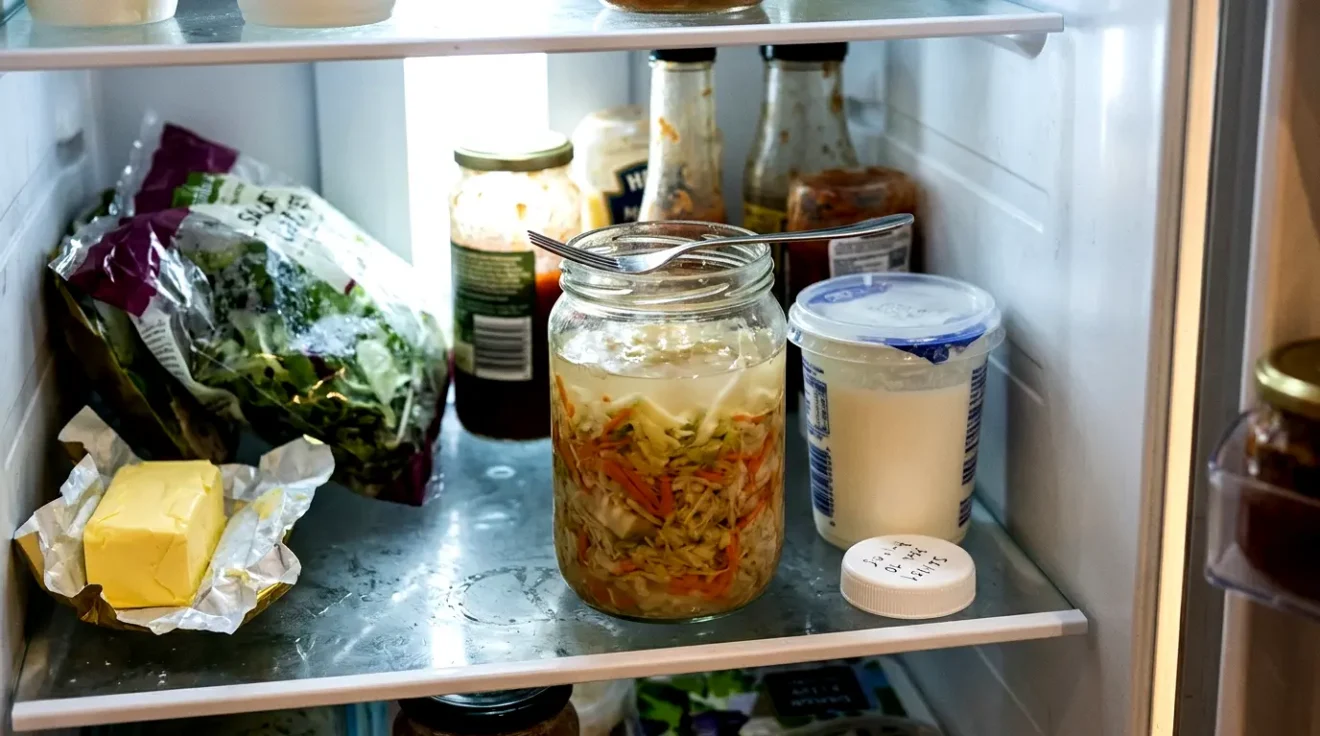
Always distinguish a use-by date from a best-before date. A use-by date concerns safety and should not be exceeded, even if the food looks or smells normal. A best-before date generally concerns quality, provided the food has been stored appropriately, but opening instructions and other safety requirements still apply.
Visible mould, unexpected discolouration, a putrid smell or abnormal swelling of a container may indicate a problem. Some fermented foods naturally smell sour or release gas, so the interpretation depends on the product. Nevertheless, an unexpectedly swollen or damaged container or suspicious food should not be consumed. Appearance and smell alone cannot establish that a product is safe.
Package size is a useful preventative measure against waste. Someone who uses sauerkraut only as an occasional garnish may benefit from a smaller jar, even if the larger format has a lower price per kilogram.
It can help to note the opening date on a container, but that reminder must be used alongside the manufacturer’s instructions rather than as a replacement for them.
With selection, tolerance and storage covered, it becomes easier to separate the practical uses of fermented foods from the scientific terminology surrounding gut health.
Why Are Probiotics and Prebiotics Not the Same Thing?
Probiotics are live microorganisms that provide a health benefit when administered in adequate amounts, whereas prebiotics are substances selectively used by host microorganisms that confer a health benefit. They act in different ways and are not interchangeable. Importantly, not every live culture qualifies as a probiotic, and not every dietary fibre qualifies as a prebiotic.
The distinction is particularly relevant when discussing fermented foods. A yoghurt or kefir may contain living microorganisms, but their presence alone does not demonstrate that the product meets the scientific definition of a probiotic. Specific microorganisms, appropriate quantities and supporting evidence for a health benefit matter.
Prebiotics operate differently. Certain dietary components can be used by microorganisms already living in the body. Some recognised prebiotic ingredients are types of fermentable fibre, although the scientific category is broader than fibre alone.
Foods such as garlic, onions, leeks, oats, legumes and relatively unripe bananas can provide different forms of fibre and other carbohydrates that may be fermented by gut microorganisms. However, describing all these foods as containing scientifically established prebiotics would oversimplify their composition.
| Term | What it describes | Everyday context |
|---|---|---|
| Live cultures | Living microorganisms present in a product | Some refrigerated yoghurts and kefirs |
| Probiotics | Live microorganisms meeting criteria for demonstrated health benefit at an adequate amount | Specific studied strains or combinations, not every fermented food |
| Prebiotics | Substrates selectively used by host microorganisms that confer a health benefit | Particular established ingredients, including certain fermentable fibres |
| Dietary fibre | A broad nutritional category covering different indigestible carbohydrates and related substances | Oats, vegetables, wholegrains, beans and fruit |
Another term sometimes encountered is synbiotic. Scientifically, it describes a mixture comprising live microorganisms and substrates selectively utilised by host microorganisms that confers a health benefit. A synbiotic is not simply any meal containing yoghurt and oats, and the precise scientific classification should not be confused with marketing descriptions.
British food-labelling rules also make terminology important. The UK government position described earlier distinguishes regulated probiotic health claims from ordinary descriptions of food ingredients or live cultures. EU rules similarly regulate health claims, although the precise interpretation and permitted wording should not be assumed to be identical in every jurisdiction.
For shoppers, the practical implication is that an unfamiliar scientific term should never replace basic label reading. Ingredients, nutritional information, serving suggestions and credible evidence about a specific product are more meaningful than broad promises about restoring or transforming gut health.
These roles do not need to be combined in a specialised recipe: they can simply be considered across the meals and snacks of a normal day.
How Can You Create a Gut-Friendly Day Using Ordinary Meals and Snacks?
A gut-friendly day can be built around ordinary meals by including varied fibre sources and, if desired, a familiar fermented food. Porridge, wholemeal sandwiches, vegetables, pulses and fruit provide practical starting points. Yoghurt or kefir can be optional additions, but there is no requirement to combine specific prebiotic and probiotic products at each meal.
For example, an ordinary day might begin with porridge made from oats, milk or a suitable alternative, and a banana. Someone who enjoys natural yoghurt could add it alongside breakfast. The oats and fruit contribute dietary components that are distinct from the live cultures potentially present in the yoghurt.
Lunch could be a wholemeal sandwich with a familiar filling and salad vegetables. A small serving of sauerkraut might complement the sandwich, but it is not necessary for the meal to be nutritionally worthwhile.
For dinner, a vegetable and bean stew with brown rice or potatoes with their skins can provide additional fibre-containing foods. A little miso might be used for flavour in an appropriate recipe, although it can also be omitted.
Snacks could involve fruit, nuts or plain yoghurt according to appetite, preferences and dietary requirements. There is no need to add a fermented drink simply because breakfast already included a fermented food.
Illustrative example: a flexible weekday menu
This is a hypothetical meal pattern, not a clinical study or a prescribed diet. Breakfast consists of porridge, fruit and optional plain yoghurt. Lunch is a wholemeal sandwich with vegetables and, if enjoyed, a little sauerkraut. Dinner is a bean and vegetable meal, with fruit or nuts available as snacks.
The purpose is to demonstrate how familiar ingredients can provide dietary variety without requiring multiple fermented products or a specialist eating plan. Actual nutritional adequacy depends on portions, overall food choices and individual needs.
This approach is consistent with the emphasis on varied fibre sources in NHS advice on increasing dietary fibre. UK government guidance recommends 30 grams of dietary fibre daily for adults as part of a balanced diet. That recommendation concerns total dietary fibre, not a required amount of fermented food or scientifically defined prebiotics.
30 g per day
The UK adult dietary fibre recommendation. It is a general dietary target, not a dose for fermented foods, live cultures or probiotic products.
NHS guidance on dietary fibre, reviewed 2 March 2026.
When beginning, one dietary change is easier to assess than several simultaneous additions. Someone could first establish a comfortable breakfast routine with oats and, if desired, yoghurt before experimenting with another product later.
The same flexibility applies to real-life constraints. A packed lunch can use wholemeal bread and vegetables without fermented ingredients. Vegetarian meals can include beans, lentils and wholegrains. People shopping on a budget can prioritise familiar, affordable fibre-containing staples instead of buying specialist products.
Days without fermented foods are not failures. Dietary quality depends on the overall pattern of eating, and the different components of a balanced diet can be distributed across meals rather than assembled into a single supposedly perfect combination.
Once this broader pattern is established, fermented foods can be judged by their genuine contribution to everyday eating instead of being treated as an essential health intervention.
Key takeaways before choosing your routine
- Judge a fermented product by its actual ingredients, processing and suitability for your meals, not by the general reputation of fermentation.
- Consider how comfortably a product fits your household’s tastes, dietary needs, food budget and safe storage capacity.
- Keep ordinary fibre-rich foods and dietary variety as the foundation, whether or not fermented products become regular purchases.
How Do Probiotics and Prebiotics Fit Into Everyday Gut-Friendly Eating?
Probiotics and prebiotics can have distinct roles in nutrition, but everyday gut-friendly eating does not depend on deliberately consuming both. A varied, balanced diet with sufficient fibre remains the foundation. Fermented foods can add flavour, variety and useful nutrients, while specific probiotic or prebiotic benefits should only be expected where appropriate scientific evidence supports them.
Research into intestinal microorganisms has increased interest in fermented foods, probiotic strains and dietary components used by the gut microbiota. However, scientific evidence cannot be reduced to the idea that all fermented foods improve everyone’s digestive health.
Fermented foods differ in their microorganisms and nutrient composition. Even where a particular strain or intervention has been studied, findings do not necessarily apply to every product containing related microorganisms or to every individual consuming it.
Likewise, the broader importance of dietary fibre should not be confused with a guarantee that a particular fibre source will deliver a specific microbiome-related outcome. Individual responses vary, and foods are consumed as part of complex dietary patterns.
For most everyday meal planning, a useful priority is to include varied vegetables, fruits, wholegrains, pulses and other suitable fibre sources while maintaining an adequate overall diet. Fermented foods may complement that pattern, rather than replace its basic components.
There is also a practical limit to pursuing dietary variety through specialist purchases. A person who enjoys yoghurt may already have an easy way to include one fermented food. Someone who dislikes sour flavours, cannot tolerate certain products or finds them disproportionately expensive can still build a varied diet without them.
The decision can therefore be based on three ordinary questions:
- Do I enjoy it? An addition should suit existing meals and personal preferences.
- Can I use it comfortably and safely? Dietary tolerance, individual restrictions and proper storage matter.
- Does it fit my overall diet and budget? A fermented product should not displace more important food choices or create unnecessary expense.
If the answers are favourable, there is little reason to complicate the choice further. If not, choosing other nutritious foods is reasonable. No fermented food is universally required, and the evidence does not justify promising specific digestive, immune or other health outcomes from routine consumption alone.
Two common mistakes are worth avoiding: treating one fermented product as a shortcut to better health, and overlooking the ordinary details that determine whether it is practical to eat regularly. Taste, affordability, suitable quantities, food safety and overall dietary balance are all relevant.
Choose one food you genuinely like, consider where it belongs in your existing routine and try it without expecting a measurable health transformation. If it proves convenient and enjoyable, keep it; if not, continue prioritising a varied, fibre-rich diet.
Can plant-based yoghurt be a fermented-food option?
Yes. Some plant-based yoghurts are made using fermentation cultures and may contain live microorganisms when consumed. However, nutritional composition varies considerably by ingredient and formulation. Check protein, calcium fortification, added sugars and culture information rather than assuming a plant-based product has the same nutritional features as dairy yoghurt.
Does heating a fermented food make it nutritionally useless?
No. Heating may reduce or eliminate viable microorganisms, but the food can still contribute nutrients, flavour and other components from its ingredients and fermentation. Cooked miso dishes and sourdough bread are examples of foods that remain useful in meals without necessarily providing living fermentation cultures.
Is homemade fermentation the same as buying fermented food from a supermarket?
Not necessarily. Homemade and commercial products can differ in ingredients, microorganisms, processing, consistency and safety controls. Home fermentation requires appropriate hygiene, reliable tested methods and suitable storage. It should not be assumed that a homemade product is safer, contains more useful microorganisms or offers greater health benefits.
Can people who avoid dairy still include fermented foods?
Yes. Fermented cabbage, kimchi, miso and certain plant-based yoghurts may provide dairy-free options, depending on their ingredients. Always check packaging for milk, fish, shellfish, soya and other relevant allergens or unsuitable ingredients. Dairy-free fermented foods are optional additions, not replacements for ensuring adequate nutrients from the wider diet.
Do fermented foods need to be eaten every day?
No. There is no established universal daily requirement for fermented foods as a category. Their role depends on the particular product and the overall diet. Eating them occasionally, regularly or not at all can be compatible with a balanced dietary pattern, provided nutritional needs are met through appropriate food choices.