
A carton of milk, a bag of frozen peas and a packet of chocolate biscuits are all processed foods. Yet treating them as nutritionally equivalent simply because they have undergone industrial processing would make everyday food choices unnecessarily confusing.
The degree of processing matters, but it is only one part of food quality. Some techniques preserve nutrients, improve safety or make nutritious ingredients more accessible. Others produce convenient combinations of refined starches, added sugars, salt and fats that may contribute to a less balanced diet when consumed frequently.
For shoppers in England, the practical challenge is distinguishing between these situations without turning every supermarket visit into an investigation. Understanding processing categories, checking nutrition information and recognising misleading marketing claims offers a more reliable approach than avoiding everything sold in a packet.
The useful question is not simply whether a food has been processed. It is what processing has changed, what the finished product provides nutritionally and how often it features in your diet.
Processed foods: what matters most
- Processing is not automatically harmful: freezing, pasteurisation, canning and fortification can preserve food safety, convenience and nutritional value.
- Look beyond processing categories: compare saturated fat, sugars, salt, fibre and ingredients rather than relying exclusively on ultra-processed food labels.
- Prioritise repeated purchases: improving everyday drinks, cereals, snacks and ready meals can be more practical than eliminating every processed product.
- Why Is Processed Food Not Automatically the Same as Unhealthy Food?
- How Can You Assess a Processed Food Without Relying on a Single Label?
- Plain Oats, Instant Oats or Granola: Which Level of Processing Fits Your Needs?
- What Can Go Wrong When You Avoid Every Food You Consider Processed?
- Which Processed Foods Should You Review First When Improving Your Weekly Shop?
- Why Does One Positive Nutrition Claim Not Make an Ingredient High Quality?
- How Can You Check Whether a New Nutrition Claim Is Worth Acting On?
- How Can You Judge the Nutritional Quality of Ingredients Beyond Marketing Claims?
Why Is Processed Food Not Automatically the Same as Unhealthy Food?
Processed food is not automatically unhealthy because processing describes what happens to an ingredient, rather than the nutritional quality of the finished food. Freezing vegetables, pasteurising milk and fortifying flour serve different purposes from producing highly formulated snacks. The effects on health depend on the resulting nutrients, dietary context and frequency of consumption.
Food processing covers an enormous range of techniques. Washing, chopping, drying, freezing, heating and fermenting can change food while preserving much of its nutritional usefulness. Pasteurisation reduces harmful microorganisms in milk, while freezing allows vegetables to remain available outside their growing season.
Fortification is another example. Many plant-based drinks contain added calcium and vitamins that help make them more useful alternatives to dairy products. In the UK, certain non-wholemeal wheat flours are already fortified with specified nutrients, with mandatory folic acid fortification due to take effect on 13 December 2026.
These interventions should not be confused with industrial formulation designed primarily around flavour intensity, texture, shelf life and convenience.
The NOVA classification groups foods according to their processing characteristics, including a category commonly called ultra-processed foods, or UPFs. It can help identify highly formulated products, but it does not directly measure their vitamin content, fibre, salt or overall nutritional value.
For example, a packaged wholegrain bread may have an extensive ingredient list yet provide useful fibre. Conversely, a food made with relatively few ingredients can still contain substantial quantities of saturated fat or salt. Fermented foods also differ in how they are classified, depending on the actual ingredients and manufacturing process.
51%
Estimated proportion of dietary energy from ultra-processed foods among UK adults in National Diet and Nutrition Survey data discussed by SACN. Classification limitations apply, and this is not a current 2026 consumption estimate.
UK Scientific Advisory Committee on Nutrition, SACN’s 2025 evidence update on processed foods and health.
The scientific concern is nevertheless substantial. SACN’s review identifies consistent associations between higher UPF consumption and adverse health outcomes. However, much of the evidence is observational, so it remains uncertain how much of the risk arises independently from processing rather than nutritional composition or other characteristics of diets and lifestyles.
That distinction matters when interpreting recommendations. A food’s processing category can alert you to look more closely, but it should not replace examining what the product contains.
Once processing is treated as a clue rather than a verdict, supermarket labels become more informative and less intimidating.
How Can You Assess a Processed Food Without Relying on a Single Label?
Assess processed foods by combining three checks: front-of-pack traffic lights, nutrition information per 100g or 100ml, and the ingredients list. Traffic lights highlight nutrients worth reviewing, standardised figures enable comparisons, and ingredient order reveals the product’s composition. No single indicator establishes whether a food deserves a regular place in your diet.
Start with the traffic light information displayed on many foods sold in England. Green indicates a low amount of a particular nutrient, amber a medium amount and red a high amount. These indicators commonly cover fat, saturated fat, sugars and salt, although not every product uses the voluntary front-of-pack scheme.
A red indicator does not mean a product must be forbidden. It means that nutrient deserves attention, particularly if the product is eaten frequently or in substantial portions.
The next step is comparing similar products using the per-100g information on the back or side of the packaging. This avoids relying on manufacturer-selected serving sizes, which may differ considerably from what you normally eat.
The following NHS thresholds provide a useful reference for solid foods.
| Nutrient | Low | High |
|---|---|---|
| Total fat | 3g or less | More than 17.5g |
| Saturated fat | 1.5g or less | More than 5g |
| Total sugars | 5g or less | More than 22.5g |
| Salt | 0.3g or less | More than 1.5g |
These thresholds apply to foods rather than drinks, which have different criteria. Total sugars also include naturally occurring sugars, so this figure should not be mistaken for a direct measurement of added or free sugars. The NHS guidance on reading food labels explains how to use these indicators together.
Finally, inspect the ingredients list. Ingredients are generally presented in descending order of weight, meaning those appearing first contribute the greatest individual quantities at the time they are used.
Look for the main food ingredients, followed by any added sugars, refined starches, oils, flavourings, stabilisers or other components. Names such as dextrose and glucose-fructose syrup indicate added sugar ingredients, while maltodextrin indicates a refined carbohydrate that is not always counted as sugar on the nutrition panel.
A lengthy list may justify closer inspection, but ingredient count is not a validated measure of nutritional quality. Neither are additives automatically harmful simply because their names are unfamiliar.
A practical decision rule is to review products with several unfavourable nutritional indicators, particularly when refined starches, sugars or added fats dominate the formulation. Compare them with alternatives in the same category rather than rejecting them immediately.
This routine is especially useful when products share a familiar base ingredient but differ substantially in their formulation.
Plain Oats, Instant Oats or Granola: Which Level of Processing Fits Your Needs?
Plain oats usually offer the simplest formulation, instant oats provide additional convenience, and granola combines oats with ingredients that can increase sweetness, fat content and energy density. None is automatically unsuitable. The most useful choice depends on ingredients, portion size, fibre content, preparation time and whether the product helps you maintain a balanced breakfast.
Oats demonstrate how processing changes a familiar ingredient without necessarily changing its underlying identity.
Plain rolled oats are steamed and flattened, making them easier to cook while retaining their wholegrain character. Unflavoured instant oats are often cut or rolled more finely and may be precooked, but this additional processing does not inherently make them nutritionally poor.
Flavoured instant oat sachets introduce another consideration: formulation. Depending on the product, they may contain sugar, milk powder, salt, flavourings or other ingredients. Their nutritional profile therefore needs checking rather than assuming all instant oats have the same composition.
Granola typically combines oats with ingredients such as oils, syrups, nuts and dried fruit before baking. These additions can create an appealing texture and contribute useful nutrients, but may also increase calories per 100g and make portions easier to underestimate.
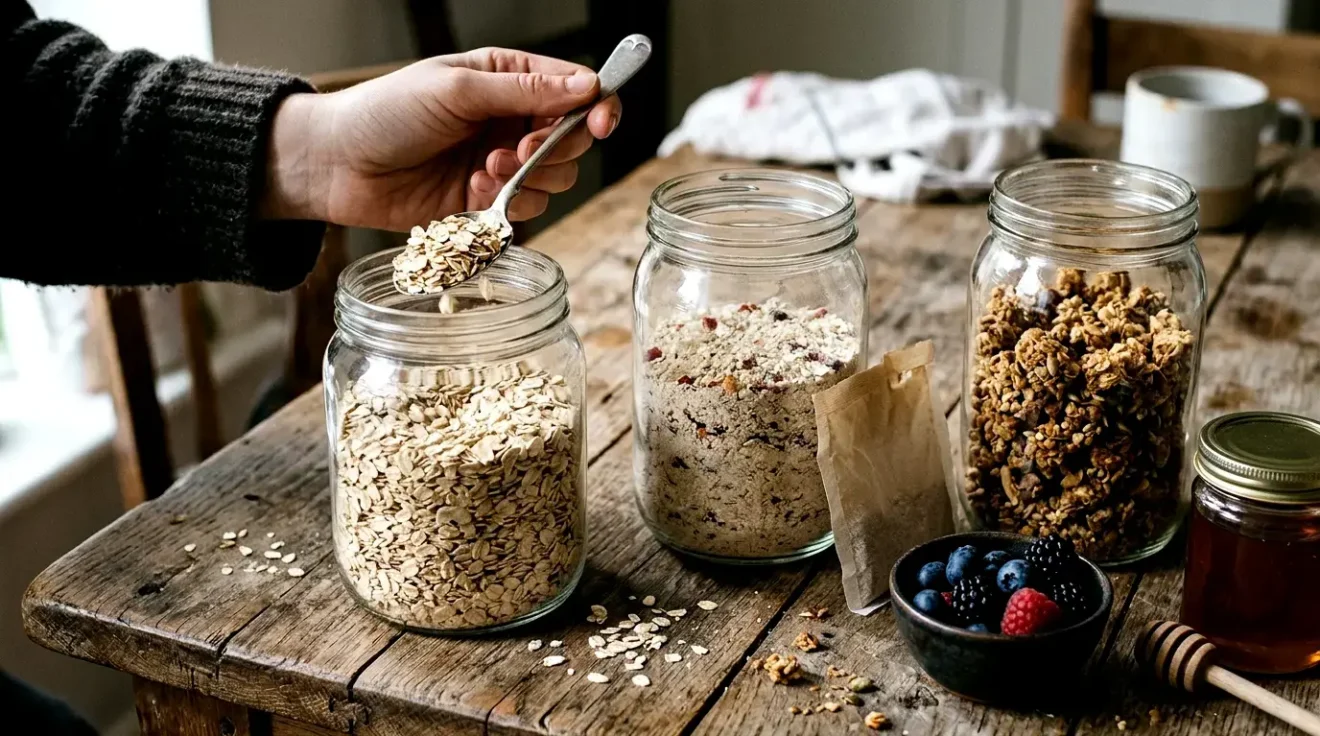
Comparing these options is more useful when the criteria are specific rather than based on an assumed ranking of processing levels.
| Feature | Plain rolled oats | Flavoured instant oats | Granola |
|---|---|---|---|
| Typical formulation | Usually oats alone | Oats with possible sweeteners or flavourings | Oats with varying combinations of oils, syrups and other ingredients |
| Preparation | Cooking or soaking | Usually rapid preparation | Normally ready to eat |
| Main label check | Portion and additions | Sugars, salt and fibre | Energy, sugars, saturated fat and portion size |
| Practical advantage | Control over ingredients | Convenience | Texture and variety |
For a fair comparison, check equivalent weights rather than comparing one small granola serving with a larger bowl of porridge. Look at the fibre content, the sources of sweetness and the overall nutritional composition.
Fruit can add natural sweetness, but the distinction matters: sugars within intact fruit are not treated in the same way as free sugars added through honey, syrups or fruit juice concentrates.
A useful middle option is plain oats prepared with milk or a suitable fortified plant drink, topped with berries and nuts. A little honey can be added according to preference, with the amount kept visible rather than hidden in the recipe.
However, if a convenient instant sachet means eating a satisfying breakfast rather than skipping it, convenience is a legitimate nutritional consideration.
The objective is to select a breakfast that works regularly, not to choose the least processed option regardless of preparation time, appetite or cost.
What Can Go Wrong When You Avoid Every Food You Consider Processed?
Avoiding every processed food can make eating more expensive, time-consuming and restrictive without necessarily improving nutritional quality. It may also remove useful sources of fibre, protein, vitamins and minerals, including fortified foods and preserved ingredients. A more sustainable approach is to reduce nutritionally weaker products while keeping convenient foods that contribute to a balanced diet.
Consider how much ordinary cooking relies on processing. Frozen fish, canned tomatoes, tinned chickpeas, pasteurised milk and wholemeal bread all save time or make ingredients easier to store and use.
Removing them can create practical difficulties, particularly for households managing limited budgets, irregular working hours or access to shops.
Frozen vegetables can reduce waste because only the required quantity needs to be cooked. Tinned beans provide a convenient source of fibre and plant protein. Choosing varieties without added salt or with lower salt content can make them particularly useful pantry staples.
Fortified foods also deserve attention. Some breakfast cereals contribute iron and B vitamins, certain spreads contain added vitamin D, and appropriately fortified plant drinks can supply calcium or vitamin B12. Their usefulness depends on the specific product and the individual’s dietary requirements.
Rejecting all such products because they have been industrially altered overlooks the difference between beneficial processing and less favourable formulation.
There is also a behavioural cost to rigid rules. A food system divided into permitted and forbidden items can make shopping, social meals and family routines harder to manage. For some people, strict avoidance may encourage cycles of restriction and overeating, although this is not an inevitable response for everyone.
A gradual substitution strategy is generally easier to fit into daily life. Rather than removing all packaged snacks, for example, a household might reduce the frequency of particularly sugary options while retaining familiar favourites occasionally.
This is consistent with the emphasis of UK public health advice: improve the overall balance of foods, especially by reducing products high in energy, saturated fat, salt and free sugars and low in fibre.
There is no nutritional requirement to achieve a diet containing zero products classified as ultra-processed.
The next decision is therefore which products deserve attention first, not which entire supermarket aisles should disappear from the shopping list.
Which Processed Foods Should You Review First When Improving Your Weekly Shop?
Start with processed foods and drinks that you buy frequently and that contribute substantial amounts of free sugars, salt, saturated fat or excess energy to your usual diet. Soft drinks, sugary cereals, processed meats, ready meals and packaged snacks are practical categories to review. Frequent, manageable changes generally offer more opportunity than occasional substitutions.
Frequency matters because a modest improvement to something consumed every day can influence the overall dietary pattern more than replacing a product bought only occasionally.
Begin by considering sweetened drinks. Comparing regular soft drinks with unsweetened or no-added-sugar alternatives may reveal substantial differences in sugar content. Water remains a straightforward everyday option, but preferences, suitability and other ingredients still matter when selecting substitutes.
Breakfast cereals offer another opportunity. Two products marketed towards the same age group can differ in sugars, fibre and salt. In children’s products especially, colourful packaging and added-vitamin claims should not distract from the nutrition panel.
Processed meats are worth reviewing because frequent consumption has implications beyond convenience and processing classification. Replacing some portions with beans, lentils, eggs or suitable fish options can vary the diet while changing its nutritional composition.
Ready meals require a more individual assessment. A vegetable-rich meal with useful protein and moderate salt may be a practical choice, while another product in the same category could be high in saturated fat and salt. The category name alone does not distinguish them.
Packaged snacks can similarly be compared by portion size, frequency and nutritional profile rather than automatically eliminated.

Instead of attempting a complete cupboard overhaul, choose one product category each week. Compare the usual brand with realistic alternatives, then decide whether a change improves the nutritional profile while meeting taste, convenience and budget requirements.
Your five-step weekly food shopping audit
- Identify one repeated purchase: write down a product category you buy most weeks, such as breakfast cereal or ready meals. Deliverable: one clearly named category to review.
- Record the current product: note its saturated fat, sugars, salt and fibre per 100g where available. Deliverable: a short nutritional reference for your usual choice.
- Compare two alternatives: examine equivalent nutrition values and the main ingredients. Deliverable: a three-product comparison.
- Check practical suitability: compare price, preparation time, taste expectations and typical portions. Deliverable: one preferred alternative with a reason for choosing it.
- Test and evaluate the swap: use the alternative during normal meals and decide whether it is worth buying again. Deliverable: a keep, adjust or reject decision for the next shopping list.
A product that looks excellent on paper but goes uneaten or creates unnecessary expense is not necessarily the most useful choice.
Once regular products have been compared, it becomes easier to recognise why a prominent nutrition claim should never determine the entire purchasing decision.
Why Does One Positive Nutrition Claim Not Make an Ingredient High Quality?
A positive nutrition claim describes a particular attribute, not the complete nutritional quality of a product. A biscuit may qualify as a source of fibre while remaining high in sugars or saturated fat. Similarly, high-protein and no-added-sugar claims can be accurate without making the product a better overall choice than a simpler alternative.
Packaging often draws attention to whichever characteristic makes the product most attractive. This creates a health halo: consumers may interpret one favourable message as evidence that the whole food is nutritionally superior.
Consider a packaged snack advertised as high in protein. The protein content may meet the applicable legal conditions, but the product could also contain substantial saturated fat, salt or refined ingredients.
Whether the snack is a useful option depends on the quantity and sources of protein, its other nutrients and what it would replace in the diet.
Similarly, a breakfast cereal marketed as a source of fibre could still be high in total sugars. The fibre claim does not cancel out the need to examine the remainder of the label.
The expression no added sugar requires careful interpretation. A product may contain naturally occurring sugars, while certain concentrated fruit ingredients can contribute free sugars. The legal conditions governing sugar claims should not be reduced to the assumption that a product is low in sugar.
Reformulation introduces further complications. A manufacturer might reduce sugar while introducing sweeteners or other carbohydrates to maintain texture. Reducing fat can also change how sweetness, flavour or mouthfeel is achieved, though these substitutions are not universal.
Each adjustment should be evaluated on its own merits.
When a marketing claim attracts attention, translate it into a comparison question: how much of the advertised nutrient does the product deliver, and how does the complete composition compare with a familiar alternative?
For a protein bar, that could mean comparing protein, saturated fat, sugars and price with plain yoghurt, nuts or another convenient snack. These foods are not nutritionally interchangeable in every respect, but the exercise reveals whether the claimed advantage is meaningful.
The main ingredients also matter. Protein from pulses, dairy or whole foods may come with other useful nutrients, while added protein isolates contribute to protein content without necessarily providing the same overall nutritional package.
The next step is determining whether a particular claim is regulated, supported and relevant to what you actually need.
How Can You Check Whether a New Nutrition Claim Is Worth Acting On?
Check a nutrition claim by asking whether it addresses a genuine dietary need, whether the product delivers a meaningful advantage over comparable foods, and whether its complete nutritional profile supports the message. Authorised claims must meet regulatory conditions, but legal permission to make a claim is not proof that the product is the healthiest available option.
In England, nutrition and health claims used in commercial food communications are subject to Great Britain’s regulatory framework. The official register identifies permitted and rejected claims and provides a route for checking the conditions applying to regulated statements.
A nutrition claim concerns the nutritional properties of a food, such as its protein or fibre content. A health claim relates a food, nutrient or substance to health, subject to relevant authorisation and conditions of use.
The wording and required conditions matter. A statement about calcium contributing to the maintenance of normal bones is different from a vague suggestion that a food is generally good for your body.
Consumers can consult Great Britain’s official register of nutrition and health claims to investigate whether a specific regulated claim is authorised. The register applies to Great Britain, including England, rather than automatically establishing the rules for Northern Ireland.
Informal expressions such as clean, guilt-free or gut-friendly require separate scrutiny. Their presence is not equivalent to an independently verified health benefit, and whether particular wording constitutes a regulated health claim depends on its meaning and context.
Use three questions before acting on a new claim:
- Is it relevant? A product with added protein may offer little practical benefit if your normal diet already meets your needs.
- Is the difference substantial? Compare the claimed nutrient with an ordinary version of the same product, using consistent quantities.
- Does the rest of the label support it? Examine sugars, saturated fat, salt, fibre, ingredients and realistic portions.
Price provides a final proportionality check. A product offering a modest additional amount of one nutrient may not justify a considerable premium, particularly if the standard version already contributes to a balanced diet.
The same reasoning applies to emerging food trends. Scientific-sounding language, influencer endorsements and impressive packaging do not establish that a product will improve health outcomes.
With this distinction established, the complete judgement can return to the ingredients themselves and their nutritional contribution.
Key takeaways before choosing
- Begin with formulation: identify the main ingredients and the purpose of additional components before judging a food by its processing category.
- Compare like with like: evaluate nutrition information using consistent weights and suitable alternatives rather than isolated claims.
- Decide in dietary context: frequency, portions, convenience and affordability determine whether a substitution is genuinely useful.
How Can You Judge the Nutritional Quality of Ingredients Beyond Marketing Claims?
Judge ingredient quality by examining what a food contains, how those ingredients contribute to its nutritional profile and how the finished product fits into your usual diet. Start with the degree of processing as a prompt for scrutiny, then assess ingredient order, nutrition information per 100g and the relevance of any claims before deciding whether to keep or replace it.
The ingredients list provides an important starting point because it reveals the food’s composition without depending on the manufacturer’s preferred marketing message.
Under UK government requirements for ingredient lists, ingredients are generally declared in descending order of weight. This makes the beginning of the list particularly useful when determining what contributes most to the formulation.
For example, a tomato-based sauce beginning with tomatoes has a different composition from one where substantial quantities of other ingredients appear first. Likewise, an oat product with wholegrain oats as its main ingredient differs from a cereal dominated by refined flour and added sugars.
However, the first three ingredients do not necessarily account for most of a product’s total weight. Ingredient proportions vary, and several different sugars or starches may appear separately. The full list therefore remains important.
Do not assume that an unfamiliar additive indicates danger. Many additives identified by E-numbers have been assessed for permitted food uses. Their presence can provide information about a product’s intended texture, stability, appearance or shelf life, but cannot independently establish that it is harmful.
Some additives improve preservation and consistency. Others support flavour or texture in highly formulated foods. The relevant question is how these ingredients contribute to the finished product alongside its nutritional characteristics.
The nutrition panel provides the necessary second perspective. A short ingredient list can still accompany a product high in saturated fat, while a more complex formulation may deliver fibre, protein or important added micronutrients.
Consider a hypothetical comparison between two packaged tomato soups. One has tomatoes as the leading ingredient but a relatively high salt content. Another contains additional thickeners yet provides more vegetables, less salt and a similar energy value. Processing complexity alone would not establish which is nutritionally preferable for everyday consumption.
The same principle applies when comparing plain and flavoured yoghurt, wholegrain breads, plant-based drinks or prepared meals. Establish what the products contribute before assigning them a simple healthy or unhealthy label.
A coherent decision sequence is therefore straightforward:
- Identify whether the product is minimally processed, conventionally processed or highly formulated.
- Read the main ingredients and look for substantial additions of sugars, refined starches, fats or salt.
- Compare energy, saturated fat, sugars, salt and fibre per 100g or 100ml with a relevant alternative.
- Check that any prominent nutrition or health claim is meaningful and does not distract from less favourable characteristics.
- Consider how often the food is eaten, the typical portion and whether a realistic alternative would improve the overall diet.
This approach avoids two common mistakes: assuming that every highly processed food is nutritionally poor, and assuming that minimally processed ingredients automatically produce a balanced diet.
It also aligns with the broader direction of UK scientific advice. The strongest practical case for reducing processed food consumption concerns products high in energy, saturated fat, salt and free sugars, particularly when they displace fibre-rich and nutritionally valuable foods.
At the next weekly shop, choose one frequently purchased product, compare it with a realistic alternative and change it only if the nutritional improvement also works for your budget, tastes and routine. Repeating this manageable process is more useful than trying to eliminate processing itself.
Are frozen vegetables considered processed food?
Yes. Freezing is a form of food processing, and some vegetables are also blanched before freezing. Plain frozen vegetables are generally classified as minimally processed rather than ultra-processed. They can be a nutritious, convenient alternative to fresh produce, particularly when they contain no added sauces or salt.
Does a long ingredient list mean a food is unhealthy?
No. A long ingredient list can suggest a more complex formulation, but it is not a reliable nutritional verdict. A product may contain numerous useful ingredients, while one made from only a few ingredients can still be high in saturated fat, sugar or salt. Check the quantities, nutritional profile and main components.
Are all ultra-processed foods equally concerning?
No. Ultra-processed foods vary substantially in their nutritional composition. Some packaged wholegrain breads and fortified products can contribute useful nutrients, while sugary drinks and certain heavily formulated snacks may be less favourable when consumed frequently. Research identifies associations between higher overall UPF consumption and adverse health outcomes, but the risks and evidence differ across food categories.
Is an organic food necessarily less processed?
No. Organic production and food processing describe different characteristics. An organic packaged biscuit can still contain refined flour, sugar and fats, while a conventionally produced frozen vegetable can remain minimally processed. Organic status should not replace reading the nutrition information and ingredients list.
Can a ready meal be part of a balanced diet?
Yes. A ready meal can be a practical option when it provides a suitable balance of vegetables, protein and other nutrients without excessive salt or saturated fat. Compare similar meals using their nutrition panels and consider portion size and what else you eat during the day. Convenience does not automatically make a meal nutritionally unsuitable.