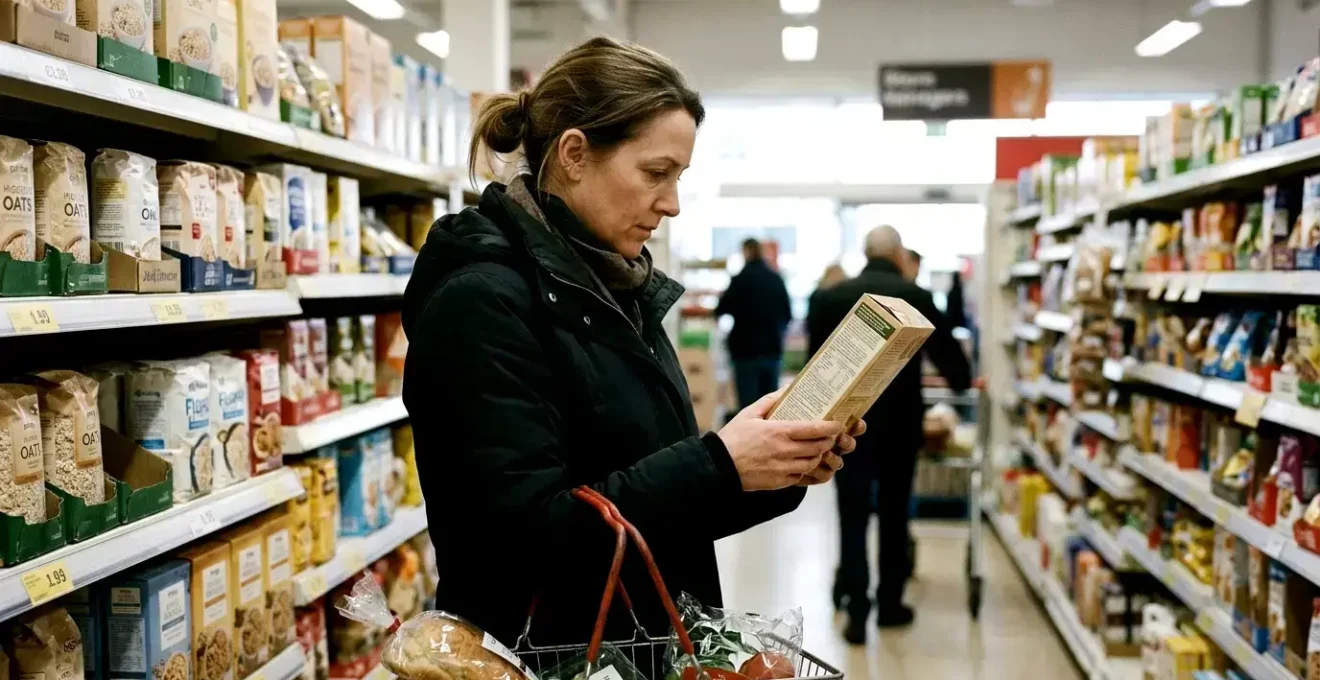
A packet of breakfast cereal promises extra protein. A bottle of cooking oil advertises its premium origins. A vegetable is labelled fresh, while an apparently identical alternative sits in the freezer. Which is actually the better nutritional choice?
The answer rarely appears in the largest lettering on the packaging. Ingredient quality depends on nutritional composition, the form of the food, how it has been processed and how it fits into meals you actually prepare. Freshness and price matter too, but neither guarantees a better nutritional result.
For shoppers in England, the most useful approach combines the ingredients list, nutrition information per 100 g, realistic portions and the food’s intended purpose. It also means recognising when inexpensive frozen or tinned ingredients provide more practical value than expensive alternatives.
Learning to make these comparisons can improve shopping decisions without turning every supermarket visit into a complicated nutritional calculation.
How to recognise genuinely useful ingredients
- Judge the whole food, not one attractive claim such as high protein, low fat or natural.
- Compare ingredients, nutrition per 100 g, actual serving sizes and the role a food plays in your meals.
- Choose between fresh, frozen, tinned and premium options according to nutritional value, practicality, variety and waste.
- Why Does One Positive Nutrition Claim Not Make an Ingredient High Quality?
- How Can You Assess an Unfamiliar Ingredient Before Adding It to Your Weekly Shop?
- Fresh, Frozen or Tinned: Which Form Offers the Best Everyday Nutritional Value?
- When Can a Premium Ingredient Offer Little Nutritional Advantage Over a Basic Version?
- When Should You Choose Frozen Ingredients Instead of Fresh to Preserve Practical Quality?
- How Can You Assess a Processed Food Without Relying on a Single Label?
- How Can You Check Whether a New Nutrition Claim Is Worth Acting On?
- How Much Does the Degree of Processing Matter When Choosing Everyday Foods?
Why Does One Positive Nutrition Claim Not Make an Ingredient High Quality?
A positive nutrition claim describes one characteristic of a food, not its complete nutritional quality. A product can legitimately qualify as high in protein or a source of fibre while also containing substantial amounts of salt, saturated fat or sugar. Assessing its quality requires examining the entire composition rather than accepting one favourable feature as a verdict.
In England, nutrition claims and health claims operate under specific regulatory requirements. The Department of Health and Social Care information on nutrition legislation explains how authorised health claims and the conditions governing nutrition claims apply in Great Britain.
A claim such as high in protein must satisfy defined conditions. Similarly, source of fibre has a regulated nutritional meaning. These requirements make authorised claims more informative than vague promotional phrases, but they do not establish that the entire product is nutritionally balanced.
Consider two hypothetical supermarket products. One cereal prominently advertises added protein but contains considerable added sugar. Another has no prominent health claim but provides wholegrain ingredients and a useful amount of fibre. The protein claim might be accurate, yet it would be insufficient to identify the first cereal as the better everyday choice.
The same principle applies to low-fat and no-added-sugar products. Removing fat does not automatically make a recipe nutritionally preferable; some formulations compensate with other ingredients. No added sugar does not mean sugar-free or low-calorie, since a product may naturally contain sugars or derive much of its energy from refined starches.
Three checks help put a headline claim into perspective:
- Read the ingredients list to identify the main components and any prominent sources of added sugar, fats or salt.
- Compare energy and relevant nutrients per 100 g with a comparable product.
- Consider how extensively the food has been formulated and whether it contributes something useful to your usual diet.
It is also important to distinguish regulated nutritional statements from broader promotional language. Expressions such as wholesome, premium or naturally delicious may create a healthy impression without providing a comparable nutritional measurement. Even when a claim falls within a regulated category, its wording and presentation should not be confused with an independent assessment of the entire product.
A trustworthy claim can inform a purchase, but it should never replace a comparison of the food itself. This becomes particularly important when considering an ingredient you have never bought before.
How Can You Assess an Unfamiliar Ingredient Before Adding It to Your Weekly Shop?
Assess an unfamiliar ingredient by identifying what it contains, how it has been prepared, what nutritional role it could serve and whether you are likely to use it. A food with an impressive nutrient profile offers limited practical value if it does not suit your cooking habits, budget or preferred meals. Start with one realistic use rather than buying it for its reputation.
The first distinction is between a relatively simple ingredient and a formulated product. A new grain, vegetable, spice or cooking oil needs a different assessment from a prepared sauce, meat alternative or breakfast product.
With a raw vegetable, useful questions concern its condition, storage requirements, edible yield and intended cooking method. With a packaged sauce, the ingredients list and nutrition panel reveal far more about how the product fits into your meals.
According to the GOV.UK rules on food ingredients lists, ingredients in applicable packaged foods are generally declared in descending order of weight, with the main ingredient first. Highlighted ingredients may also require percentage declarations.
This matters when a product is marketed around one desirable ingredient. A sauce promoted for its tomatoes, for example, may contain additional components that meaningfully affect its nutritional profile. Ingredient order helps identify its composition, although it cannot establish overall quality without the nutrition panel.
A practical four-step assessment works well:
- Identify the ingredient’s composition. For packaged mixtures, find the main ingredients and any relevant allergens. For single-ingredient foods, establish what the food is and how it is normally prepared.
- Consider processing and storage. Determine whether the product is dried, fermented, frozen, cooked or heavily formulated, and whether that makes it more useful or less suitable for your needs.
- Place it in a real recipe. Decide what it would replace, how much you would normally serve and whether the cooking method changes its appeal.
- Try a small quantity. Test one meal before committing to a larger or more expensive purchase.
For example, a new wholegrain might replace some white rice in a familiar dish. A different variety of beans could substitute for part of the meat in a stew. Frozen spinach could replace fresh spinach in a cooked curry, while a new vegetable might be tested in a soup before being purchased regularly.
These comparisons are more meaningful than simply asking whether an unfamiliar ingredient is fashionable or rich in a particular nutrient.
Origin labels deserve the same balanced treatment. A named country, region or certification may communicate provenance, production standards or other characteristics. It does not automatically demonstrate that the ingredient contains more vitamins or minerals. Where origin information is required or supplied, treat it as one dimension of the purchase rather than a nutritional score.
An ingredient earns a place in the weekly shop when its nutritional contribution and culinary usefulness justify the space, cost and effort. That often depends as much on its format as on the food itself.
Fresh, Frozen or Tinned: Which Form Offers the Best Everyday Nutritional Value?
Fresh, frozen and tinned foods can all contribute meaningful nutrition to everyday meals. Their relative value depends on the ingredient, time since harvest, preservation process, additional ingredients and preparation method. Fresh is not automatically superior, while frozen and tinned versions can provide dependable nutrition with greater convenience and less waste.
Fresh vegetables may be particularly appealing when eaten soon after purchase, especially where crisp texture matters. However, the word fresh says little about the time spent in transport, storage and supermarket displays. Some nutrients are sensitive to time, temperature and preparation, so visible freshness cannot determine vitamin content on its own.
Frozen vegetables are often processed close to harvest, reducing the need for extended storage before consumption. Nevertheless, some vegetables are blanched before freezing, and that heating process can reduce certain heat-sensitive or water-soluble vitamins. Freezing therefore should not be treated as a guarantee of better nutrient retention.
Tinned foods undergo different preservation processes. Their nutritional contribution can remain substantial, although salt, syrup and other additions deserve attention.
The NHS advice on what counts towards 5 A Day recognises fresh, frozen and canned fruit and vegetables. An 80 g portion generally counts as one portion, with the NHS recommending canned options in water or natural juice without added salt or sugar.
80 g
An NHS 5 A Day portion of fresh, frozen or canned fruit and vegetables generally weighs 80 g. This establishes dietary portion equivalence, not identical vitamin content across preservation methods.
National Health Service, 5 A Day guidance.
Different foods make the trade-offs clearer. The following comparisons are practical shopping guidance, not laboratory rankings of nutrient retention.
| Ingredient | Useful options | What to check |
|---|---|---|
| Green peas | Fresh or frozen for cooking; tinned for convenience | Texture, added salt and the amount you will actually use |
| Spinach | Fresh for salads; frozen for cooked dishes | Whether raw texture matters and how much cooking is required |
| Beans and pulses | Dried or tinned | Salt, preparation time and suitability for the recipe |
| Tomatoes | Fresh for salads; tinned for sauces and stews | Added salt, recipe requirements and seasonal flavour |
| Fish | Fresh, frozen or tinned, depending on species and use | Species, added ingredients, storage and food safety |

For tinned pulses, draining and rinsing is a sensible way to remove some of the salty packing liquid. However, the precise sodium reduction depends on the product and method, so rinsing should not replace checking the label. Choosing a no-added-salt version is another option.
Tinned fruit packed in syrup can contribute additional sugar compared with fruit packed in water or natural juice. Likewise, tinned fish should be evaluated according to its species and the oil, brine or sauce in which it is packed, rather than treating all canned fish as nutritionally interchangeable.
There is also a practical distinction between nutritional content when purchased and nutrition actually eaten. A bag of fresh vegetables that spoils before cooking provides no nutritional benefit. An appropriately stored frozen portion used in a meal may therefore be the better household choice.
The best format is often the one that preserves useful nutritional value while making regular consumption affordable and realistic. This same reasoning applies when comparing ordinary ingredients with premium alternatives.
When Can a Premium Ingredient Offer Little Nutritional Advantage Over a Basic Version?
A premium ingredient may offer little nutritional advantage when its higher price mainly reflects branding, provenance, production methods, packaging or flavour rather than a meaningful difference in composition. Paying more can be worthwhile for culinary or ethical reasons, but those benefits should be distinguished from improved nutrition. The comparison needs to focus on measurable differences and actual use.
Consider olive oil. Extra virgin olive oil is produced using mechanical extraction methods and can retain distinctive flavour and naturally occurring compounds that differ from those in refined oils. However, both extra virgin and refined olive oils are predominantly fats, and their basic energy contribution is broadly similar.
Extra virgin may justify its price when its flavour or particular composition matters to the buyer. That does not mean a more expensive bottle automatically delivers a proportionate nutritional benefit, or that every premium olive oil is equally valuable.
Similar questions arise with bread. An attractive artisan loaf might be made primarily from refined flour, while a less expensive supermarket wholemeal loaf may contribute more fibre. The words artisan and premium describe aspects of the product’s identity, not a guaranteed nutritional advantage.
Organic products require another distinction. Organic certification relates to specified production requirements. It is not, by itself, a reliable measurement of an individual food’s vitamin or mineral content. Buyers may legitimately value particular production practices without treating the label as evidence of universally superior nutrition.

Other comparisons can reveal genuine nutritional differences. With fish, choosing an oily species rather than a lean white fish changes the amount and type of fat supplied, including omega-3 fatty acids. But this is primarily a distinction between nutritional compositions, not evidence that the most expensive fish is always the best.
A useful purchase decision separates three questions:
- Nutritional value: Does the premium ingredient supply a meaningful advantage in fibre, protein, fatty acid composition or another relevant nutrient?
- Culinary value: Does its flavour, texture or performance noticeably improve the intended dish?
- Other values: Are its origin, certification, production practices or other characteristics worth paying for independently of nutrition?
The household budget introduces an additional consideration. Suppose, hypothetically, that spending more on a premium oil leaves less money for vegetables, pulses or wholegrain staples. The purchase could reduce opportunities for dietary variety despite the quality of the individual oil.
This is not a measured consequence of buying premium ingredients in general. It illustrates why the nutritional value of a shopping basket may matter more than the perceived status of one item.
Premium quality can be meaningful without being nutritionally superior. Once taste, provenance and dietary contribution are considered separately, it becomes easier to spend selectively and preserve money for foods that make everyday meals more varied.
When Should You Choose Frozen Ingredients Instead of Fresh to Preserve Practical Quality?
Choose frozen ingredients when they suit the recipe, can be stored and used safely, and allow you to prepare nutritious meals without unnecessary spoilage. They are especially practical for cooked vegetables, fruits used in blended dishes and foods needed in small quantities. Fresh ingredients remain preferable when raw texture, immediate use or a particular culinary result matters most.
The distinction starts with the difference between apparent freshness and effective nutritional quality. A vegetable displayed in a fresh produce aisle may have spent time in storage and transport. A frozen equivalent may have been preserved earlier, although blanching and subsequent cooking can also influence nutrient retention.
Neither format guarantees a higher level of every vitamin. For a household shopper, the more useful question is whether the ingredient will remain usable until the meal is prepared.
Frozen peas, spinach and mixed vegetables are convenient for quick cooking because a measured amount can be taken from the pack. Frozen berries can work well in porridge or smoothies where their softened texture is not a disadvantage. Small portions of frozen herbs may also be useful when a recipe needs only a little at a time.
Fish can be practical to buy frozen when it will not be cooked promptly after purchase, provided the product is stored, thawed and prepared according to its instructions. Freezing does not make handling precautions unnecessary.
By contrast, fresh salad leaves, crunchy vegetables and fruit intended to be eaten raw often provide a texture that freezing cannot preserve. Fresh produce may also be the simplest choice when it will be prepared soon after purchase and used completely.
Choosing frozen therefore involves a trade-off between texture, storage, preparation and likely waste.
| Cooking situation | Usually more practical | Main reason |
|---|---|---|
| Quick vegetable side dish | Frozen | Easy portioning and convenient preparation |
| Raw salad or crunchy garnish | Fresh | Better preservation of the desired raw texture |
| Fruit for a blended smoothie | Frozen | Suitable texture and flexible quantities |
| Small amounts of cooking herbs | Frozen | Less need to use a whole fresh bunch |
| Vegetables needed immediately and entirely | Fresh | No freezing or thawing required |
Frozen foods still have limitations. Ice crystal formation can damage the structure of some ingredients, causing them to soften when thawed. In vegetables that were blanched before freezing, a proportion of certain vitamins may already have been lost during processing.
Cold-chain management also matters. Follow the packaging instructions, keep frozen products at the recommended storage temperature and avoid prolonged exposure to warm conditions. If food has thawed, whether it can safely be refrozen depends on how it was thawed, handled and, where applicable, cooked. Automatic refreezing without considering those factors is not a sound practice.
Price comparisons should account for edible and usable amounts, not just the displayed price per pack. Frozen produce that can be portioned over several meals may offer better value than fresh produce that is only partly consumed.
The most useful frozen purchase is one that becomes part of a real meal rather than remaining forgotten in the freezer. Practical quality ultimately depends on what is prepared and eaten, which makes careful assessment of packaged and processed products equally important.
How Can You Assess a Processed Food Without Relying on a Single Label?
Assess processed food by combining its ingredients list, nutrition per 100 g, front-of-pack indicators and the portion you actually eat. Each reveals something different: composition, nutrient levels, comparative warnings and real dietary contribution. No single label can establish quality independently, and the presence of processing or additives is not enough to declare a product nutritionally poor.
A useful supermarket habit is to read the back of the pack before allowing front-of-pack descriptions to influence the decision. Pictures of fruit, grains or vegetables may emphasise an appealing ingredient without showing how much is present in the finished product.
Begin with ingredient order. Look for the main components and note where sugar, syrups, refined starches, oils or other relevant ingredients appear. This can reveal whether the product is built around ingredients you intended to buy.
Ingredients lists also identify additives and allergens. Their length alone is not a reliable health score: a product containing several ingredients can be nutritionally useful, and an additive’s presence does not establish harm. What matters is the purpose and overall composition of the food.
Next, compare nutritional information per 100 g or 100 ml. This provides a common basis for evaluating similar products even when their manufacturers suggest different serving sizes.
For example, imagine two hypothetical sauces:
- Sauce A contains 6 g of sugar per 100 g and suggests a 50 g serving.
- Sauce B contains 4 g of sugar per 100 g and suggests a 100 g serving.
Sauce A lists 3 g of sugar in its suggested portion, while Sauce B lists 4 g. But the portion figures are not directly comparable because one serving is twice the size. Per 100 g, Sauce B contains less sugar. The relevant total intake then depends on how much sauce is actually eaten.
UK traffic-light nutrition labels can also help shoppers compare the levels of fat, saturated fat, sugars and salt where such labels are provided. A green, amber or red indicator offers a quick reference, but it should be read alongside the full nutrition panel rather than used as an overall verdict.
Finally, consider the processing itself. Freezing, pasteurisation and fermentation can support safety, preservation or food preparation. More elaborate formulations may involve refined components and added salt, sugar or fats, but the nutritional consequences should be established from the finished product rather than assumed solely from the technique.
Five checks to complete before choosing a packaged food
- Write down the first three ingredients and identify the main components of the product.
- Record energy, saturated fat, sugars, salt and any nutrient especially relevant to your comparison per 100 g or 100 ml.
- Compare those figures with one similar product using the same measurement basis, noting the meaningful differences.
- Estimate the quantity you would actually eat and record the corresponding nutrient contribution.
- Write a one-sentence purchase decision explaining what the product contributes, what its limitations are and what it would replace.
This method also helps prevent overreaction to unfamiliar technical ingredient names. A food’s nutritional value cannot be determined simply by counting ingredients or identifying scientific-sounding terms.
Once a label has been assessed systematically, a product can be judged according to its actual contribution to meals. The same evidence-based approach is useful when an emerging nutrition trend promises benefits that have not yet been established in ordinary eating conditions.
How Can You Check Whether a New Nutrition Claim Is Worth Acting On?
Check a new nutrition claim by identifying who makes it, whether credible evidence or recognised authorities support it, and whether the claimed benefit applies to the quantities and foods you would actually consume. A promising laboratory result or promotional statement is not automatically a reason to change your diet. Evidence quality and everyday relevance both matter.
Nutrition claims appear in advertising, social media posts, news articles, product descriptions and research summaries. These sources do not carry equal evidential weight, and even accurate findings can be presented with more certainty than the underlying research allows.
Start by identifying the source. Is the statement from a food manufacturer, a journalist summarising research, a scientific publication or an official public health body? A commercial interest does not automatically make a claim false, but it increases the importance of checking the evidence independently.
The second step is to look for an assessment by a recognised authority. In England, NHS guidance and relevant UK government information can help establish whether a proposed dietary change is consistent with accepted recommendations. Scientific assessments from organisations such as EFSA may provide additional context, although the applicable rules for claims made in Great Britain must be checked separately.
The third step is to test whether the evidence translates into a normal food purchase.
Suppose, as a hypothetical example, that an article reports a benefit from a particular plant compound. Before purchasing an expensive product advertised around that compound, ask whether the research examined people or animals, how much was used, how the compound was administered and what outcome was measured.
A compound tested in a concentrated preparation cannot automatically be assumed to have the same effect when consumed in a small quantity within an ordinary meal. Similarly, an effect observed in a particular study population may not apply equally to everyone.
Several warning signs deserve closer attention:
- Research is described as definitive despite being preliminary or based on a small sample.
- Results from animals or laboratory experiments are presented as established human benefits.
- The advertised product contains an unspecified or much smaller amount of the studied substance.
- Only favourable findings are mentioned while limitations or conflicting evidence are ignored.
- A modest measured change is translated into a large promise about health or wellbeing.
Uncertainty is not the same as proof that a claim is false. It simply means the evidence may not justify the purchasing decision being encouraged.
There is also a useful dietary substitution test. If a new ingredient replaces a less suitable existing product and helps maintain nutritional variety, it may be worth considering. If it simply adds expense, calories or unnecessary complexity to an otherwise balanced diet, its practical benefit is less clear.
For people with specific medical conditions, allergies or dietary restrictions, general promotional claims should not substitute for individual professional advice.
Good evidence should inform a proportionate decision, not trigger an immediate overhaul of familiar meals. This brings the assessment back to a broader question: how much weight should food processing itself carry when judging quality?
Key takeaways before making your final choice
- A preservation or preparation technique should be evaluated by what it changes, not merely by whether it counts as processing.
- Nutrition panels and realistic portions provide a firmer basis for comparison than fashionable labels or premium positioning.
- A useful ingredient should improve the balance, variety or practicality of meals without creating unnecessary cost or waste.
How Much Does the Degree of Processing Matter When Choosing Everyday Foods?
The degree of processing matters because it can affect nutritional composition, texture, convenience and the way foods are consumed. However, it is not a complete measure of quality. Freezing, drying, fermentation and canning can make nutritious foods accessible, while some highly formulated products contain substantial added sugar, salt or saturated fat. The finished food and its dietary role remain decisive.
The term processed covers a broad range of activities. Washing and freezing peas, fermenting yoghurt, baking bread and manufacturing a ready-to-eat snack all change food in different ways. Treating these processes as nutritionally equivalent would obscure the very differences shoppers need to understand.
At one end, processing can preserve food, improve usability or reduce preparation time. Tinned beans provide a convenient source of plant protein and fibre. Frozen vegetables can be cooked directly from storage. Wholemeal bread turns grain into an accessible everyday staple, while fermentation contributes to the character and production of foods such as yoghurt.
At the other end, some manufactured foods combine refined ingredients, added sugars, salt, fats, flavourings and other components in formulations that differ substantially from simpler alternatives. These features may warrant closer assessment, especially when the product becomes a frequent part of the diet.
Processing classifications, including NOVA, are one way of describing differences between foods. Yet an individual product’s processing category cannot replace information about its nutrients, ingredients and appropriate dietary use.
In practical shopping, examine the listed components without assuming that every unfamiliar ingredient is undesirable. Syrups, modified starches, flavour enhancers and hydrogenated fats may indicate particular formulation choices worth investigating, but their presence does not automatically determine the nutritional value of the entire product.
For instance, a packaged wholemeal loaf may contain several ingredients beyond flour, water and yeast while still being a useful source of wholegrain carbohydrate and fibre. Conversely, a simpler-looking sweet product may supply little of the nutritional variety needed in an everyday diet.
The NHS Eatwell Guide places individual choices in the wider context of food groups and dietary balance. Its guidance emphasises that balance can be achieved over a day or week rather than at every single meal.
This is a valuable corrective to ingredient perfectionism. A household does not need every ingredient to be fresh, minimally processed, expensive or rich in a fashionable nutrient. What matters is whether the overall pattern includes suitable variety across food groups and supports the person’s nutritional needs.
A final assessment can therefore combine the whole article into a repeatable supermarket routine:
- Composition: Check which ingredients dominate and what the nutrition panel shows.
- Processing: Identify whether preparation or preservation improves practicality or introduces characteristics worth limiting.
- Form: Choose fresh, frozen, dried or tinned according to the food and intended recipe.
- Value: Compare the useful amount obtained against its cost, likely waste and genuine nutritional differences.
- Dietary fit: Ask whether the ingredient provides variety, replaces something less suitable or simply duplicates an existing purchase.
These considerations need not all carry equal weight. Someone shopping for raw salad vegetables may prioritise texture and freshness. Someone preparing economical weekday stews may put greater emphasis on pulses, frozen vegetables and convenient storage. A shopper comparing breakfast products may focus primarily on fibre, added sugar and portion size.
The central principle is consistency: use the same relevant criteria when comparing similar products, rather than allowing each packet to define what quality means through its own marketing language.
On your next weekly shop, choose two products you regularly buy and compare their ingredients, nutrition per 100 g, realistic portions and intended use. Keep the option that best supports the meals you actually prepare, even if its packaging makes fewer promises.
Does a shorter ingredients list always mean healthier food?
No. Ingredient count alone does not establish nutritional quality. Some foods with several ingredients can provide valuable fibre, protein or other nutrients. Compare the main ingredients and nutrition panel instead of treating a short list as an automatic advantage.
Are traffic-light labels mandatory on every food sold in England?
No. The familiar UK front-of-pack traffic-light nutrition labelling scheme is voluntary, so its absence does not establish that a product is nutritionally poor. When these indicators are available, use them alongside the detailed nutrition information and your actual serving size.
Can tinned beans count towards 5 A Day?
Yes. Under NHS guidance, an 80 g serving of beans or pulses can contribute one portion towards 5 A Day. However, beans and pulses count as a maximum of one portion per day regardless of how much is eaten. Choosing versions without added salt can help when comparing tinned products.
Does an organic label guarantee more vitamins and minerals?
No. Organic certification communicates specified production requirements rather than a guaranteed vitamin or mineral advantage. The nutritional composition of a food also depends on factors such as its variety, handling, storage and preparation. Organic products may be chosen for other legitimate reasons without assuming universal nutritional superiority.
Should an ingredient with additives automatically be avoided?
No. The presence of additives does not automatically make a product unsafe or nutritionally inferior. Consider their function, the overall ingredients, the nutrition panel and how frequently the food is eaten. A balanced assessment is more informative than rejecting every product containing unfamiliar ingredient names.