
A bowl of yoghurt with oats, a serving of lentils and a spoonful of fermented vegetables might all contribute to gut-friendly eating, but they do not work in exactly the same way. Some foods contain living microorganisms, while others provide substances that gut bacteria can use. Understanding that distinction makes food choices easier and helps prevent unnecessary spending on supplements.
Probiotics are live microorganisms with demonstrated health benefits when consumed in adequate amounts. Prebiotics are substances selectively used by microorganisms in ways that provide a health benefit. Certain dietary fibres have prebiotic effects, although not all fibre qualifies as prebiotic. Similarly, not every fermented food contains established probiotics.
For everyday eating in England, a varied diet rich in plant foods offers a sensible starting point. Live-culture yoghurt, kefir and other fermented foods can add variety where suitable, while oats, pulses, vegetables and wholegrains help increase fibre intake. The aim is a sustainable eating pattern, not a rigid daily formula.
Gut-friendly eating at a glance
- Probiotics and prebiotics perform different roles: one supplies beneficial live microorganisms, while the other provides substances used by existing microbes.
- Combine suitable fermented foods with varied fibre-rich ingredients, without assuming every pairing has a clinically proven synbiotic effect.
- Prioritise everyday foods, increase fibre gradually and assess supplements by their specific strains, evidence and intended purpose.
- Why Are Probiotics and Prebiotics Not the Same Thing?
- How Can You Combine Probiotic and Prebiotic Foods in One Day?
- Food or Supplement: Which Probiotic and Prebiotic Approach Fits Everyday Use Best?
- Which Probiotic Labels Can Be Misleading Without More Product Detail?
- When Should You Increase Prebiotic Foods Slowly to Improve Tolerance?
- Why Do Not All Fermented Foods Offer the Same Nutritional Features?
- How Can You Add More Fibre Without Completely Changing What You Eat?
- How Can You Support Gut Health Without Following a Complicated Diet?
Why Are Probiotics and Prebiotics Not the Same Thing?
Probiotics and prebiotics differ because they contribute different things to the gut environment. Probiotics are living microorganisms that provide a demonstrated benefit in adequate amounts. Prebiotics are substances that existing microorganisms selectively use to produce a benefit. Think of probiotics as bringing in additional workers and prebiotics as supplying suitable fuel, although the biological processes are more complex.
This distinction matters when choosing food. A live-culture yoghurt may contain bacteria used in fermentation, but it does not necessarily supply meaningful amounts of prebiotic substances. Conversely, an oat-based breakfast may provide useful dietary fibre without adding live microorganisms.
According to ISAPP‘s overview of probiotic, prebiotic and synbiotic definitions, three distinctions are especially important:
- Probiotics: specific live microorganisms shown to provide a health benefit at an adequate dose.
- Prebiotics: substrates selectively utilised by microorganisms in a way that benefits the host. Certain fibres, including recognised prebiotic compounds, meet this definition.
- Synbiotics: mixtures of live microorganisms and selectively utilised substrates that confer a health benefit.
The everyday idea behind synbiotics is useful: include foods containing live cultures alongside ingredients that supply fermentable fibre. Yoghurt with oats and banana is a convenient example. However, this combination should not automatically be described as a scientifically validated synbiotic. That would require evidence about the particular organisms, substrates and resulting benefits.
Another distinction concerns fermentation. Traditional fermentation involves microbial activity during production, but those microorganisms may not survive subsequent heating or pasteurisation. A fermented product can therefore remain nutritious without containing live cultures when eaten.
Once these terms are separated, the practical question becomes simpler: which familiar foods can provide live cultures and which can supply useful fibre throughout an ordinary day?
How Can You Combine Probiotic and Prebiotic Foods in One Day?
Combining probiotic and prebiotic food sources can be as straightforward as eating live-culture yoghurt with oats at breakfast, adding beans and vegetables at lunch, and including a modest serving of fermented vegetables with dinner. The foods do not need to appear together at every meal. Consistency, variety and digestive tolerance are more useful priorities than following a strict pairing schedule.
Consider this illustrative day using foods readily found in English supermarkets. It demonstrates how to organise meals rather than prescribing quantities or promising a particular microbiome response.
| Meal | Live-culture or fermented option | Fibre-rich accompaniment |
|---|---|---|
| Breakfast | Plain live-culture yoghurt or kefir | Porridge oats and banana |
| Lunch | Optional small side of live-fermented vegetables | Wholemeal bread, chickpeas and salad |
| Dinner | A little kimchi or miso-based accompaniment | Beans, onions, garlic and vegetables |
The simplest pairing is yoghurt and oats because both fit naturally into breakfast without requiring additional cooking. At dinner, garlic and onions can be incorporated into a familiar stew, while fermented vegetables may be served alongside it.
Such meals follow the practical logic of combining live microorganisms with plant-derived substrates. They are not proof that the ingredients act together as a clinically established synbiotic.

There is an important cooking consideration: heat can reduce the viability of microorganisms in live fermented foods. When preserving live cultures is the objective, adding kimchi after cooking or serving it cold alongside a hot dish is generally more appropriate than simmering it for a long period. The same principle applies to fermented pastes used in hot soups.
It is also unnecessary to include fermented foods at every meal. Someone who enjoys yoghurt on several mornings and occasionally eats other fermented foods can maintain that pattern while obtaining fibre from ordinary plant ingredients throughout the week.
Introducing yoghurt, kefir, kimchi and sauerkraut all at once may make it difficult to identify what causes digestive discomfort. A small number of repeatable combinations is a more practical starting point.
Food choices also involve cost, convenience and individual needs. Those considerations become especially relevant when comparing normal meals with concentrated probiotic supplements.
Food or Supplement: Which Probiotic and Prebiotic Approach Fits Everyday Use Best?
For most generally healthy adults, food is a sensible first choice because it contributes a wider range of nutrients and can fit naturally into regular meals. Supplements may be worth considering for a specific purpose, but their usefulness depends on the exact microorganisms or ingredients, studied doses and individual circumstances. A supplement is not automatically more effective because it is concentrated.
Foods offer benefits beyond their potential probiotic or prebiotic characteristics. Plain yoghurt can contribute protein and calcium, while beans, oats, vegetables and wholegrains provide fibre alongside other nutrients. A capsule generally cannot replace those broader dietary contributions.
However, supplements may provide more clearly specified strains or quantities, particularly when manufacturers publish complete product details. That does not establish effectiveness by itself: the chosen strain must have evidence relevant to the intended outcome.
| Consideration | Food-based approach | Supplement approach |
|---|---|---|
| Additional nutrients | May provide protein, minerals, fibre and other dietary components | Usually provides a narrower formulation |
| Cost | Can be incorporated into an existing food budget | May create a separate recurring expense |
| Microorganism detail | Specific strains and counts may not be disclosed | Some products specify strains and viable counts |
| Convenience | Fits established meals and shopping routines | Portable, but requires consistent product use |
| Evidence of benefit | Depends on the food and any identified microorganisms | Depends on the studied formulation, dose and purpose |
The NHS information on probiotics explains that some probiotics may help with certain symptoms of irritable bowel syndrome, while evidence supporting many other advertised benefits remains limited. Different probiotics can have different effects, so results for one strain or product cannot simply be transferred to another.
Situations involving antibiotic treatment, digestive symptoms or restrictions on fermented foods may justify discussing a particular supplement with a healthcare professional. Yet travel or antibiotic use alone does not establish that everyone needs a probiotic product.
People with weakened immunity or existing health conditions should seek medical advice before taking probiotic supplements. The safety profile of an ordinary food cannot automatically be assumed to apply to a concentrated supplement.
In England, supplements are generally regulated as foods rather than medicines. They are subject to food labelling and health-claim requirements, but do not undergo the same pre-market testing as medicines.
The next step is to examine what a product actually discloses. Numbers, reassuring terms and attractive packaging can obscure whether a meaningful strain-specific benefit has been established.
Which Probiotic Labels Can Be Misleading Without More Product Detail?
Probiotic labels can mislead when they emphasise “live cultures”, “billions of bacteria” or general digestive benefits without identifying the microorganisms and evidence behind the claim. A useful label should help establish what organisms the product contains, their viable quantity, the recommended use and appropriate storage conditions. Large numbers alone do not demonstrate a health benefit.
Start by distinguishing four types of information commonly encountered on packaging.
- “Live cultures”: indicates the presence of living microorganisms, but does not itself establish a proven probiotic effect.
- “Probiotic”: suggests a beneficial function, although the wording alone cannot establish whether a product meets the scientific definition.
- “Billions of bacteria”: communicates a quantity, but gives little information about which organisms are present or whether the amount is relevant.
- Full strain identification: provides a more useful starting point for checking whether the exact organism has been studied.
Strain identification is particularly valuable. A label giving only a broad bacterial group is less informative than one specifying the genus, species and strain designation. Even a fully identified strain does not prove that the particular product delivers a benefit; its dose, formulation and supporting evidence still matter.
Viable microorganism quantities are frequently expressed as colony-forming units, or CFU. A higher CFU figure is not necessarily preferable to a lower one. Evidence for a relevant strain at an appropriate dose matters more than the largest advertised number.
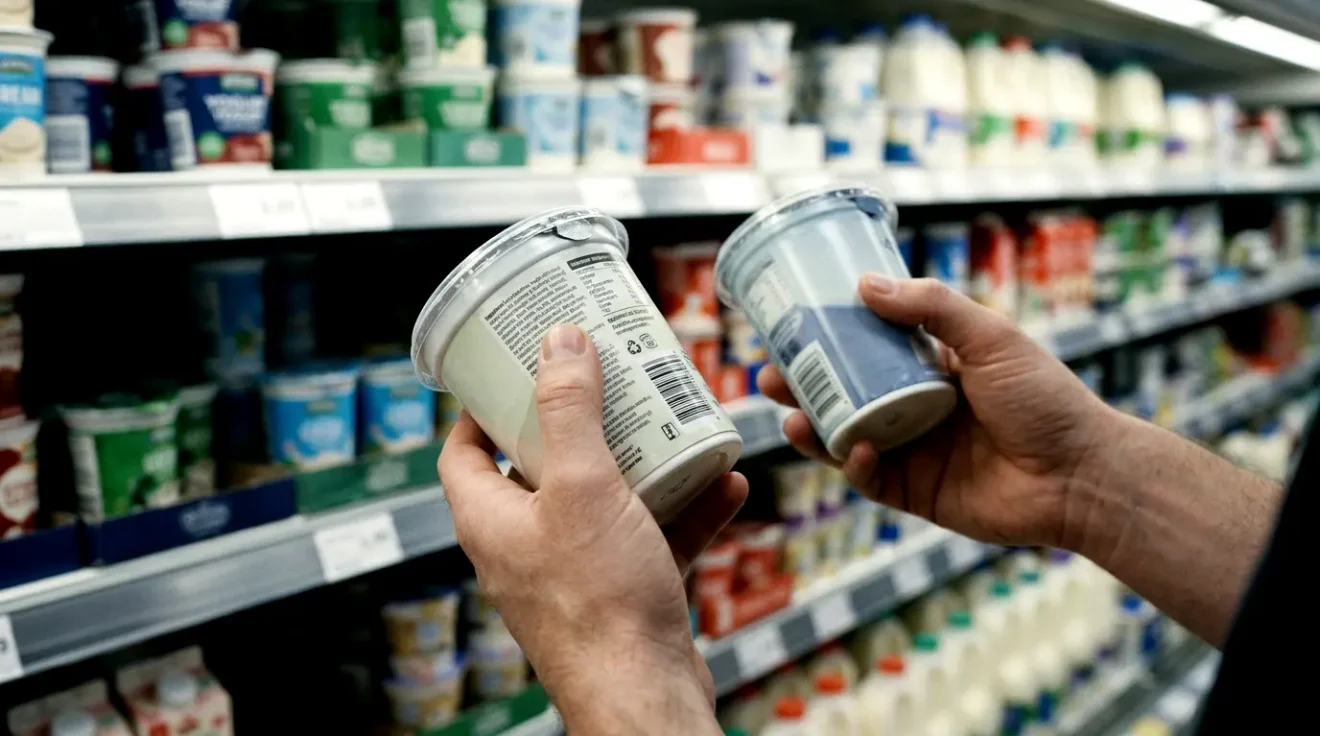
Storage instructions deserve similar attention. Some products need refrigeration to maintain their stated live-culture content, while others are formulated to remain stable without refrigeration. Follow the manufacturer’s instructions rather than assuming all probiotic products need the same conditions.
Fermented vegetables introduce another complication. A jar marked “raw”, “unpasteurised” or “with live cultures” may offer clues about processing, but none of those phrases alone proves a clinical probiotic benefit. A vinegar-pickled vegetable may be enjoyable without having undergone microbial fermentation.
UK government guidance also restricts the health claims that food businesses can make. The UK government guidance on nutrition and health claims states that foods must not be promoted as treating, preventing or curing medical conditions.
A five-step supermarket label check
- Identify the product type: write down whether it is a fermented food, a live-culture product or a supplement.
- Record the microorganisms: note the genus, species and strain code where the label provides them.
- Check the stated quantity: record any CFU information and whether the label explains when that quantity applies.
- Read storage and processing details: identify refrigeration instructions, heat treatment or other relevant preparation information.
- Assess the claimed benefit: note the exact claim and whether product-specific evidence is available, leaving unsupported benefits unconfirmed.
This brief comparison leaves you with a usable record rather than relying on front-of-pack promises. If strain information or evidence is missing, it is more accurate to recognise the uncertainty than to assume a benefit.
Once a product is reasonably understood, the next consideration is tolerance. Even nutritious foods can cause discomfort if fermentable fibre intake increases too quickly.
When Should You Increase Prebiotic Foods Slowly to Improve Tolerance?
Increase prebiotic-rich foods gradually when your usual fibre intake is low or your digestion is particularly sensitive. Gut microorganisms ferment certain dietary components, producing gases that may contribute to bloating or wind. Mild, temporary symptoms can occur during dietary changes, but persistent or significant discomfort should not automatically be dismissed as normal adaptation.
Foods such as onions, garlic, pulses and some fibre-rich cereals may introduce fermentable carbohydrates that are unfamiliar to someone whose current diet contains relatively little fibre. Larger portions or several new foods introduced together can make symptoms harder to interpret.
A practical approach is to change one ingredient at a time. For instance, someone who rarely eats lentils could begin by adding a small spoonful to a familiar soup, then maintain that portion for several days before deciding whether to increase it.
The same principle applies to adding beans to a curry, oats to breakfast or onions to a meal. The purpose is not to reach a particular amount immediately, but to establish a portion that feels manageable.
- Choose one additional fibre-rich ingredient that fits an existing meal.
- Begin with a small portion rather than a large serving.
- Keep the amount reasonably consistent for several days while observing symptoms.
- Increase the portion gradually if comfortable.
- Add another food only when the previous change is tolerated.
People with irritable bowel syndrome may be especially sensitive to certain fermentable carbohydrates, including those found in onions, garlic and some pulses. Increasing these indiscriminately may worsen symptoms rather than improve comfort. Personalised advice may be more useful than a generic high-prebiotic plan.
Discomfort that is mild, short-lived and improving may be compatible with adjusting to a change in diet. Persistent bloating, recurring pain, diarrhoea or constipation that interferes with daily life deserves assessment by a GP or registered dietitian. Severe pain, blood in the stool or unexplained weight loss should not be attributed to ordinary fibre adjustment.
Someone already eating a wide range of wholegrains, vegetables and pulses may have no reason to introduce foods at a particularly slow pace. The important variable is individual tolerance rather than a universal adjustment timetable.
Digestive comfort is also influenced by the type of fermented food chosen. These products can vary considerably in their nutritional composition, processing and live-culture content.
Why Do Not All Fermented Foods Offer the Same Nutritional Features?
Fermented foods differ because fermentation is a production process, not a guarantee of identical nutrients or probiotic effects. Yoghurt, kefir, kimchi, sauerkraut, miso and sourdough bread involve different ingredients and processing methods. Some contain living microorganisms when eaten, while others are heated, pasteurised or otherwise processed. Their protein, fibre, sugar and salt contents also vary.
Dairy-based fermented foods such as plain yoghurt and kefir may contribute protein and calcium. Their live-culture content depends on the product and processing. Sweetened versions can also contain added sugars, so comparing nutrition labels remains worthwhile.
Vegetable ferments such as sauerkraut and kimchi can provide vegetable-derived nutrients and some fibre. However, their salt content may be substantial, depending on the recipe and portion. Someone managing blood pressure or following advice to reduce sodium should factor that into their choice.
Miso is another fermented product commonly used in small quantities for flavour. Its value as an ingredient should be considered alongside its salt contribution, rather than assuming that using more will deliver greater gut-health benefits.
Sourdough bread illustrates the distinction between fermentation during production and the presence of live microbes at consumption. Although microbes contribute to dough fermentation, baking generally inactivates them. The finished bread therefore should not automatically be treated as a source of live probiotics.
Similarly, vinegar-pickled vegetables do not necessarily contain the live microbial populations associated with traditional vegetable fermentation. The presence of acidity alone is not proof of probiotic microorganisms.
For supermarket comparisons, examine the ingredients, processing description and storage instructions together. Information about cultures or fermentation can help distinguish product types, but an ingredient list cannot establish clinical effectiveness.
Plain fermented dairy, fermented vegetables and fermented condiments can all have a place in a varied diet. They should not be treated as nutritionally interchangeable or automatically superior to comparable non-fermented foods.
The broader dietary foundation remains important regardless of fermented-food preferences. For many adults, increasing fibre through ordinary meals is a more straightforward priority than expanding the number of fermented products in the fridge.
How Can You Add More Fibre Without Completely Changing What You Eat?
You can increase fibre without redesigning your diet by making small additions to meals you already enjoy. Try beans in soup, lentils in pasta sauce, wholemeal bread instead of white bread, or fruit and oats at breakfast. These changes contribute dietary fibre and greater plant variety, although not every fibre-rich food contains a scientifically established prebiotic.
The NHS recommends that adults aim for 30 grams of dietary fibre per day as part of a healthy, balanced diet. Its guidance reports average adult intake at approximately 20 grams daily, illustrating why modest improvements to familiar meals can be worthwhile.
30 g per day
Recommended daily dietary fibre intake for adults in UK guidance. This is a target for total dietary fibre, not a separate requirement for prebiotics.
Rather than treating this figure as a reason to count every gram, look for convenient opportunities within existing routines. A small number of familiar adjustments can be easier to maintain than an ambitious meal plan.
| Usual choice | Easy upgrade | Practical advantage |
|---|---|---|
| White toast | Wholemeal toast | A familiar breakfast with more fibre |
| Low-fibre breakfast cereal | Oats or a higher-fibre cereal | More fibre without changing breakfast habits |
| Plain pasta sauce | Add lentils or vegetables | Extra plant ingredients in a familiar dish |
| Soup without pulses | Stir in chickpeas or beans | More fibre and a more substantial meal |
| Refined-grain side dish | Try a wholegrain alternative | An opportunity to increase fibre through a routine staple |
When comparing packaged foods, the fibre declaration can be useful. Under the applicable nutrition-claim criteria, a food described as “high fibre” must contain at least 6 grams of fibre per 100 grams, or satisfy the equivalent energy-based criterion.
Convenience meals, takeaway lunches and restaurant dishes may provide limited fibre when they contain few vegetables, pulses or wholegrains. An easy daily check is to ask whether breakfast, lunch and dinner each included a meaningful plant-based fibre source.
Some additions, including particular fibres in oats and other plant foods, may also provide prebiotic substrates. However, the nutritional value of fibre-rich foods does not depend on proving that every ingredient is prebiotic.
Introduce changes at a manageable pace and drink adequate fluids as fibre intake rises. A familiar eating routine that gradually includes more plants is generally easier to sustain than a complete overnight overhaul.
With fibre-rich staples established, gut-friendly eating becomes less about individual products and more about a repeatable combination of variety, tolerance and sensible food choices.
Key takeaways for everyday choices
- Choose food combinations you can repeat comfortably, rather than chasing a large number of probiotic products.
- Evaluate fermented foods for their overall nutritional qualities, including processing, added sugar and salt.
- Let digestive tolerance guide the pace of fibre increases, especially when introducing unfamiliar pulses or fermentable vegetables.
How Can You Support Gut Health Without Following a Complicated Diet?
Supporting gut health does not require an elaborate diet, daily supplements or a strict collection of food rules. A practical routine is to include varied plant foods, obtain fibre regularly, enjoy suitable fermented foods if you like them, and make changes at a pace your digestion tolerates. These habits support overall nutrition without promising a particular microbiome outcome.
Begin with foods you already buy and enjoy. Wholemeal bread, porridge, vegetables, fruit, lentils and beans can provide an accessible foundation. Plain live-culture yoghurt or kefir may be convenient additions, but no particular fermented food needs to become compulsory.
Four simple habits can organise the approach:
- Include plant-based fibre throughout the day. Use familiar grains, fruit, vegetables and pulses rather than relying on one fashionable ingredient.
- Choose variety across the week. Different plant foods contribute different nutrients and types of dietary fibre.
- Enjoy fermented foods when appropriate. Select options that suit your preferences, budget and nutritional needs, without imposing an unsupported daily quota.
- Increase gradually when needed. Pay attention to digestive comfort and avoid introducing numerous unfamiliar foods simultaneously.
A weekly review can help without requiring calorie trackers, microbiome tests or specialist apps. Consider whether your main meals regularly included plants, whether you tried different fibre sources, and whether any recent changes caused symptoms.
This review does not need a numerical score. Its purpose is to identify a realistic next step: perhaps adding lentils to one regular dinner, choosing a higher-fibre breakfast or finding a fermented food you genuinely enjoy.
There is also no need to eliminate entire food groups without a clear reason. Restrictive eating patterns may reduce dietary variety and can be inappropriate for some people, particularly without professional guidance.
For persistent digestive symptoms or diagnosed conditions, broad nutrition advice has limits. People with irritable bowel syndrome, inflammatory bowel disease or other medical concerns may need a more individual approach developed with their GP or a registered dietitian.
For the coming week, choose one sustainable action: add a fibre source to a regular meal, compare two live-culture labels or try a modest serving of a familiar fermented food. Keep the change that fits comfortably into your routine, and build from there.
Can you eat prebiotic foods without taking probiotics?
Yes. Prebiotic substances are used by microorganisms already present in the body, so taking a probiotic supplement is not a prerequisite for including prebiotic foods. A varied diet containing suitable fibre sources can be part of ordinary healthy eating without additional probiotic products.
Does eating yoghurt every day guarantee a healthier gut microbiome?
No. Some yoghurts contain live cultures, but their presence does not guarantee a particular health benefit. Effects depend on the microorganisms involved, the amount consumed and the outcome being considered. Plain yoghurt can still be a nutritious food independently of any established probiotic claim.
Are all high-fibre foods considered prebiotics?
No. Dietary fibre is a broad nutritional category, whereas prebiotics must meet a more specific scientific definition involving selective utilisation by microorganisms and a resulting health benefit. Foods do not need to meet that definition to be valuable sources of dietary fibre.
Can you get live probiotics from sourdough bread?
Ordinary baked sourdough is not generally a source of live probiotic microorganisms because baking inactivates the microbes involved in fermentation. Sourdough can still fit into a varied diet, and its fibre content depends partly on the flour and recipe used.
Should you stop eating a fibre-rich food if it causes bloating?
Not necessarily. Mild bloating after a rapid increase in fermentable fibre may improve when portions are reduced and increased more gradually. However, persistent or significant symptoms should not be ignored. A GP or registered dietitian can help investigate possible causes and advise on suitable dietary adjustments.