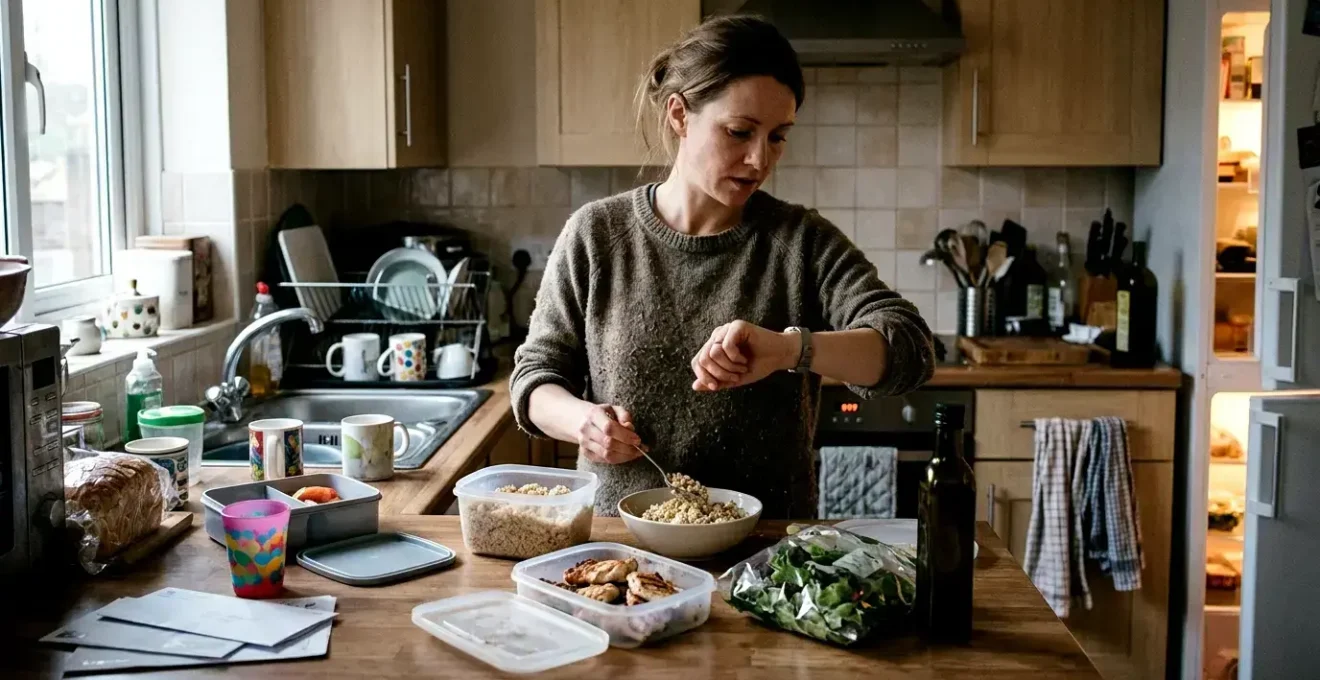
A balanced eating routine should not depend on getting home at the same time every evening. Yet conventional meal plans often assume predictable lunch breaks, regular shopping trips and enough uninterrupted time to prepare dinner. When work runs late, childcare arrangements change or an unexpected invitation appears, that carefully organised schedule can quickly become impractical.
Flexible eating patterns offer a different approach: keep the nutritional structure consistent while allowing meal times, ingredients and preparation methods to change. Instead of deciding exactly what to eat every Tuesday evening, establish a few reliable meal combinations and the ingredients that can replace one another.
This approach does not require perfect nutritional balance at every sitting. The NHS Eatwell Guide explains that people can work towards an appropriate balance across a day or even a week. That principle creates useful room for variation without abandoning healthy eating altogether.
The practical challenge is to make flexibility deliberate. A routine needs enough structure to support balanced food choices, but not so many requirements that one disrupted afternoon makes the whole plan feel impossible.
Flexible eating: the essentials
- Keep a few nutritional anchors consistent while adapting meal timing and ingredients to the day.
- Use repeatable meal templates, interchangeable ingredients and quick fallback options instead of planning every dish in advance.
- Review your routine weekly, allowing for social meals, changing commitments and ingredient freshness without starting again after disruptions.
- Why Can a Flexible Eating Pattern Be Easier to Maintain Than a Fixed Meal Schedule?
- How Can You Build Flexible Meal Templates for Days That Never Go to Plan?
- Meal Plan or Flexible Template: Which Works Better for an Unpredictable Week?
- When Does Flexible Eating Turn Into Having the Same Easy Foods Every Day?
- When Should You Plan Less Rigidly Because Your Week Includes Several Social Meals?
- How Can You Plan Five Dinners While Leaving Room for Schedule Changes?
- Fixed Meal Plan or Flexible Framework: Which Is More Sustainable Over Time?
- How Can You Build a Sustainable Dietary Framework That Works Beyond the First Few Weeks?
Why Can a Flexible Eating Pattern Be Easier to Maintain Than a Fixed Meal Schedule?
A flexible eating pattern can be easier to maintain because it accommodates interruptions without requiring the entire routine to be rearranged. Rather than depending on fixed meal times and specific recipes, it preserves basic nutritional priorities while allowing food choices and eating occasions to vary. Its main advantage is practical resilience, not the absence of structure.
Consider a hypothetical Monday when lunch is delayed by a meeting and dinner has to fit around collecting a child. Under a rigid plan, both meals might be considered missed opportunities to follow the schedule. A flexible routine treats them as ordinary adjustments: lunch happens later, and dinner uses a quicker combination of available ingredients.
Rigid routines can encourage all-or-nothing thinking when someone interprets a missed planned meal as evidence that the day has gone wrong. Flexibility can reduce that pressure by allowing a useful next choice without requiring a complete restart. This is a practical behavioural rationale, rather than a psychological effect established by the nutritional guidance cited here.
The distinction is between fixed timing and consistent nutritional structure. Timing may change, but the routine can still regularly include protein-containing foods, fruit and vegetables, fibre-rich starchy carbohydrates and suitable drinks. Portions and overall food intake should reflect individual needs, appetite and activity rather than an inflexible clock.
The NHS Eatwell Guide recommends at least five portions of a variety of fruit and vegetables daily and encourages balance across the wider diet. It does not require every meal to follow the same composition.
Irregular working hours introduce additional considerations. The Health and Safety Executive advises shift workers to consider meal size, timing and hydration, noting that lighter meals and snacks may be less likely to cause drowsiness than a single heavy meal. This supports practical adjustments during demanding shifts, although it does not establish one ideal eating schedule for everyone.
For someone finishing work at 10 pm, a lighter evening meal and an earlier substantial meal may feel more manageable than forcing a conventional dinner pattern. Another person may need a different arrangement. Hunger, concentration, sleep and comfort provide useful feedback, but no single eating window guarantees better results.
Flexibility also needs boundaries. Without a few nutritional anchors, it can gradually become a series of last-minute convenience choices.
Once that distinction is clear, the next step is building meals that can change ingredients without losing their basic purpose.
How Can You Build Flexible Meal Templates for Days That Never Go to Plan?
Build flexible meal templates by defining a small number of repeatable combinations rather than prescribing specific recipes. A practical template might contain a protein source, a starchy carbohydrate and vegetables, with additional ingredients according to appetite and preference. Keep interchangeable options available so the same structure works whether you have five minutes or half an hour.
Start with two or three meal shapes that already fit your lifestyle. These are convenient assembly patterns rather than compulsory nutritional formulas:
- A bowl: rice, potatoes or another grain, combined with beans, fish, eggs or chicken and a portion of vegetables.
- A sandwich or wrap: wholemeal bread or a wrap with a protein-rich filling and salad, accompanied by fruit or another suitable side.
- A quick cooked plate: eggs, tofu, lentils or another protein-containing food with vegetables and a starchy accompaniment.
Each template should have a small swap library. For example, the protein element in a bowl could come from leftover cooked chicken, drained tinned beans, ready-to-eat tofu or freshly prepared eggs. The vegetable element might be salad leaves, frozen broccoli or tinned tomatoes.
Arrange substitutes in a practical hierarchy based on the time available. Ready-to-eat options cover the shortest window, simple heat-and-serve ingredients cover moderately busy evenings, and fresh preparation remains available when time permits. This hierarchy is an organisational technique, not a nutritional ranking: ingredient quality and suitability still matter.

Next, establish three minimum viable meals: combinations you can normally assemble in under ten minutes when basic ingredients are available. Examples include wholemeal toast with eggs and tomatoes, a chickpea and couscous bowl with frozen vegetables, or a jacket potato prepared using a microwave and topped with beans and salad. Actual preparation time depends on the equipment, ingredients and food-safety requirements.
These fallback meals prevent the absence of a full cooking session from becoming the absence of a reasonable dinner. Keep suitable shelf-stable, frozen and refrigerated ingredients available, observing storage instructions and use-by dates.
Build your flexible meal toolkit in five steps
- Write down three meal shapes you already enjoy. Your deliverable is a list of three repeatable combinations.
- Choose at least two practical substitutes for each main component. Create a short ingredient swap list.
- Identify three meals you can normally assemble in under ten minutes. Save them as a fallback menu.
- Check your cupboards, fridge and freezer against the list. Produce a shopping note covering missing staples.
- Test one template on a busy day and record what was inconvenient. Make one specific improvement to your template.
A common design mistake is making templates almost as complicated as recipes. As a working simplification, aim for roughly three to five main components rather than a long list of required ingredients. That is a usability guideline, not an evidence-based nutritional limit.
The resulting toolkit can replace a conventional meal plan on unpredictable days, although some situations benefit from combining both methods.
Meal Plan or Flexible Template: Which Works Better for an Unpredictable Week?
A flexible template will generally be more practical when meal times, locations and cooking opportunities change frequently. A fixed meal plan can work well when the week is predictable or when detailed preparation reduces decision-making. For many people, the most workable solution is a hybrid: plan reliable meals and leave changeable ones open.
The question is not whether planning is good or bad. It is how much detail remains useful once the week begins. A fixed plan answers exactly what will be eaten and when; a template defines acceptable meal combinations without assigning every ingredient to a date.
The following grid compares their practical trade-offs rather than claiming measured differences in health outcomes.
| Decision factor | Fixed meal plan | Flexible template |
|---|---|---|
| Weekly predictability | Best suited to consistent schedules and regular mealtimes. | More adaptable when commitments change unexpectedly. |
| Available cooking time | Can organise cooking and batch preparation in advance. | Allows preparation time to vary by using ingredient swaps. |
| Food waste risk | Perishable ingredients may go unused if planned meals are cancelled. | Shared ingredients can be reassigned, although waste is still possible. |
| Shopping style | Specific quantities for predetermined recipes. | Versatile staples and ingredients suited to multiple meals. |
| Decision fatigue | Reduces daily choices because meals are already selected. | Offers more choice but requires occasional decisions. |
| Specific nutritional targets | Can make precise planning and monitoring easier. | May require additional tracking or professional guidance. |
A hypothetical example illustrates the cost difference. Someone buys ingredients for a particular Thursday recipe, then unexpectedly works late and orders a takeaway. Unless those ingredients can be stored or repurposed safely, some may be wasted. A template built around versatile ingredients offers additional ways to use them later.
However, flexibility is not automatically cheaper. Buying excessive alternatives or regularly relying on expensive ready-prepared items can increase spending. A useful template needs a realistic shopping list as well as adaptable recipes.
There is also a nutritional limitation. People managing medical dietary requirements, specific performance goals or carefully prescribed intake may need greater precision than a loosely defined template provides.
A hybrid rule offers a practical compromise: schedule meals that reliably happen at the same time, such as weekday breakfasts or a Sunday batch-cooking session, and use templates for lunches and dinners exposed to schedule changes.
To decide, observe one ordinary week. Record where and when each meal actually happened, then compare it with your original expectations. If most planned meals move, the schedule is providing poor instructions; if most remain stable, detailed planning may be helpful.
Whatever system you choose, keeping ingredients interchangeable does not automatically guarantee variety. That requires its own simple checks.
When Does Flexible Eating Turn Into Having the Same Easy Foods Every Day?
Flexible eating can become repetitive when convenience repeatedly determines food choices. If the easiest meal always wins, an adaptable routine may gradually shrink into the same few sandwiches, ready meals or pasta combinations. This is not necessarily harmful in the short term, but persistent narrow food choices can limit dietary variety.
Imagine that your evening template is always pasta with cheese because it is quick and familiar. The template technically works: it is easy to prepare, and the ingredients are reliably available. Yet if the same combination replaces nearly every other dinner, the routine may provide less variety than originally intended.
The issue is not that foods must change every day. Repeating practical meals can reduce effort and help maintain a routine. The concern arises when repetition excludes other food groups or substantially narrows the range of protein sources, vegetables, wholegrains and other foods consumed over time.
Different foods contribute different combinations of fibre, vitamins and minerals. A varied diet helps broaden nutrient intake, although repetition alone does not prove that someone has a nutritional deficiency.
Try an informal seven-to-ten-day diversity check. Look back at your recent meals and note how many distinct vegetables and protein-containing foods appear. For example, a rotation consisting almost entirely of chicken, pasta and one vegetable might benefit from additional beans, fish, eggs or tofu, alongside other vegetables.
This is a personal review exercise, not a validated dietary assessment or a diagnostic test. There is no supported universal cut-off in the supplied guidance for how many distinct foods must appear within that period.
The easiest place to improve variety is often the shopping stage. Rather than expecting an inspired decision after a late shift, make one or two substitutions before the week begins: swap a familiar vegetable for another seasonal option, or include lentils instead of the usual protein in one meal.
Frozen and tinned options can make that rotation easier without requiring frequent fresh-food shopping. Choose products and portions that suit your needs, checking labels where relevant.
Variety becomes particularly important when meals are not entirely under your control, as often happens during socially busy weeks.
When Should You Plan Less Rigidly Because Your Week Includes Several Social Meals?
Plan less rigidly when restaurant bookings, family gatherings or work meals make several eating occasions unpredictable. Instead of treating each event as a disruption, include it in the week’s normal routine. Maintain ordinary, satisfying meals around those commitments and avoid restrictive compensation strategies intended to offset eating socially.
A hypothetical week might include a Tuesday working lunch, Thursday dinner with friends and a Sunday family gathering. Prescribing specific home-cooked dishes for all three occasions would create unnecessary conflicts. A flexible plan simply leaves those meals open and organises shopping and cooking around the remaining opportunities.
Thinking across the whole week can be helpful, provided it does not become a rigid calorie budget where social meals must be earned or repaid. The NHS guidance supports assessing overall dietary balance across a day or week, rather than expecting every individual meal to meet identical proportions.
That perspective allows someone to enjoy a restaurant meal with fewer vegetables than usual while incorporating a wider range of foods during other meals. It does not require deliberately restricting food intake before or afterwards.
Social meals can also be easier when decisions are made before arriving. For example, you might decide to order a main course that sounds satisfying, include vegetables when convenient, or choose a drink based on preference rather than social pressure.
These are options, not rules. Pre-deciding one manageable element can simplify an otherwise crowded decision, while still leaving room to enjoy the occasion.
Skipping earlier meals to save calories for dinner can leave some people unusually hungry and make eating less comfortable or deliberate. The response varies between individuals, so overeating should not be presented as an inevitable consequence. A more practical approach is to eat normally throughout the day, including an appropriate snack or light meal if needed.
For someone with a long gap before an evening event, yoghurt with fruit, eggs on toast or another satisfying option can make the waiting period easier. There is no need to compensate afterwards for having attended the event.
Recurring social occasions are part of everyday life, not exceptions that invalidate healthy eating. A useful routine accommodates both shared meals and quieter evenings at home.
Once the social calendar is acknowledged, the remaining home-cooked dinners can be organised without assigning each one permanently to a weekday.
How Can You Plan Five Dinners While Leaving Room for Schedule Changes?
Plan five dinners by choosing the dishes or meal combinations in advance but leaving their exact weekdays flexible. Use the most perishable ingredients first, keep longer-lasting meals available for busier evenings and review the remaining options midweek. This anchor-and-float approach offers shopping structure without requiring the calendar to remain unchanged.
The anchor-and-float method separates two decisions: what meals are available and when each will be eaten. The five dinners are the anchors. Their positions in the week can move according to actual commitments, appetite and ingredient freshness.
For example, a hypothetical five-dinner rotation could include:
- Salmon with potatoes and green vegetables.
- Chicken and vegetable stir-fry with rice.
- Chickpea and tomato curry with rice.
- Wholemeal pasta with lentils and vegetables.
- A jacket potato with beans, cheese and salad.
None of these dishes needs to belong permanently to Monday or Tuesday. Instead, check which ingredients should be used soonest and how much time is available that evening.
Fresh fish and delicate salad leaves may require earlier use, subject to their specific storage instructions and use-by dates. Tinned beans, dried pasta and suitably stored frozen vegetables can support later meals. Food safety still takes priority over the desire to keep a plan flexible.
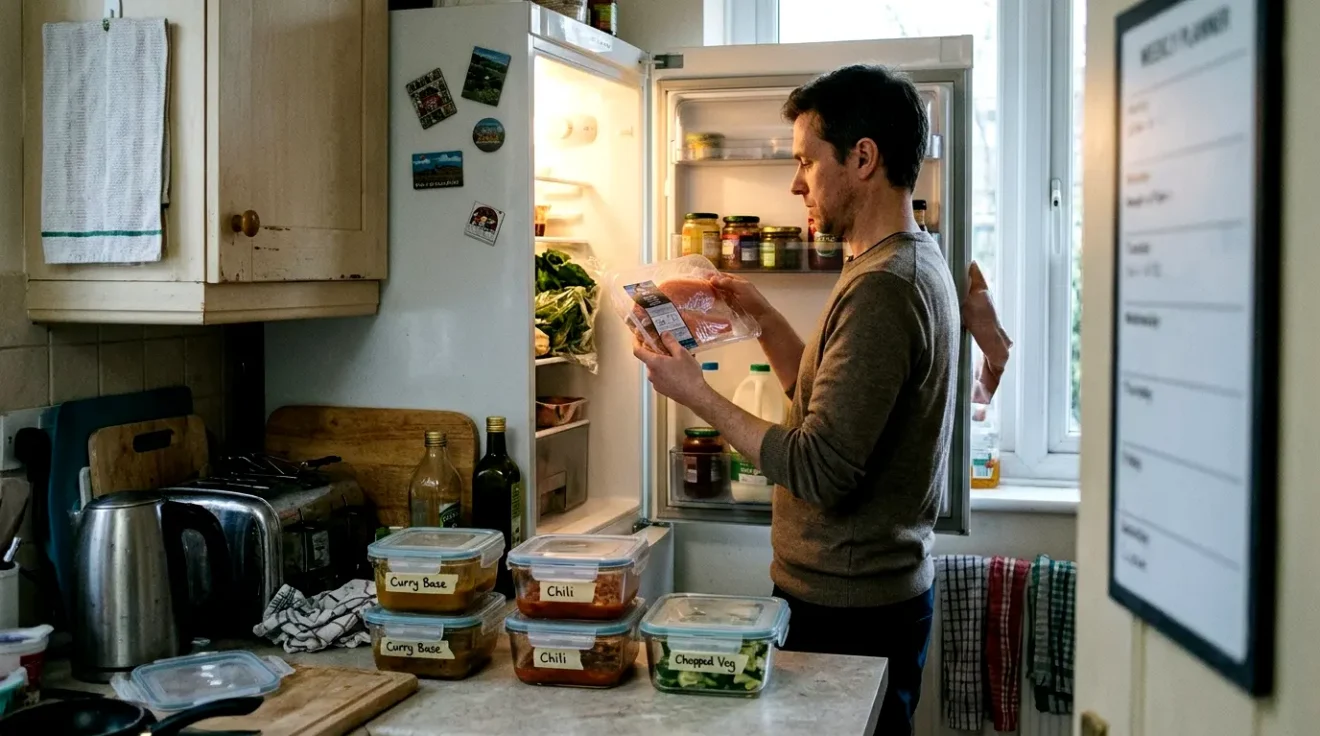
Next, deliberately overlap ingredients between two or more dinners. Rice might appear in both the stir-fry and curry, while tomatoes or vegetables could be shared between pasta and another dish. This reduces the number of single-purpose purchases and makes last-minute swaps easier.
Suppose Thursday dinner is cancelled. The chickpea curry ingredients can remain available for another evening, while suitable vegetables may be reassigned to the pasta dish. If ingredients cannot be used in time, freezing them where appropriate may be an option, following safe storage guidance.
On Wednesday, spend a few minutes reviewing what remains. Check the fridge, the food dates, upcoming commitments and which meals have already been eaten. Then rearrange the remaining dinners instead of discarding the plan.
This brief check-in makes the plan responsive rather than prescriptive. It also gives you an opportunity to notice whether the original shopping quantities were practical.
The longer-term question is whether this kind of adaptable organisation remains easier to follow than a detailed schedule over months, rather than just one busy week.
Fixed Meal Plan or Flexible Framework: Which Is More Sustainable Over Time?
A flexible framework may be more sustainable when routines regularly change because it can adapt without requiring a complete redesign. Fixed plans may suit stable schedules or people who prefer detailed instructions. Neither method is universally superior: long-term usefulness depends on nutritional needs, personal preferences and how easily the routine resumes after disruption.
A fixed meal plan can work particularly well during a predictable period. Shopping is straightforward, preparation can be scheduled and daily food decisions are largely settled. The difficulty appears when the circumstances supporting that plan change.
Consider an otherwise manageable routine disrupted by a new job, school holidays or a week away. If every meal depends on a particular time and recipe, the original schedule may no longer apply. Someone who treats the plan as indivisible may feel obliged to begin again from the start.
A flexible framework instead preserves the underlying elements: regular opportunities to eat, varied food groups, accessible ingredients and a few fallback options. The surroundings can change while the system remains recognisable.
That does not establish that flexible frameworks have a scientifically demonstrated long-term advantage over fixed plans. The supplied nutritional sources do not directly compare these planning approaches in controlled long-term studies. Their relative sustainability is best treated as a practical question to assess individually.
There are legitimate reasons to prefer greater structure. Some people find repeated decisions tiring and benefit from a predictable menu. Others need carefully defined intake because of medical requirements or specific training goals. An appropriately qualified healthcare professional or registered dietitian can help tailor nutrition when necessary.
For people with shift work, nutritional timing also requires nuance. The BDA’s article on nutrition and shift work notes that evidence is insufficient to make firm recommendations about optimal eating times for shift workers. It nevertheless emphasises dietary quality and avoiding missed meals.
This means a sustainable approach should not impose an arbitrary universal eating window on every irregular schedule.
A useful self-assessment is the one-day recovery question: after a disrupted week, can you return to your normal eating routine the following day without rewriting everything? This is a practical indicator of adaptability, not a validated measure of dietary sustainability.
If restarting requires a complete meal plan, extensive shopping or abandoning all previous progress, simplifying the routine may make it more manageable.
For lasting consistency, the next task is to turn that insight into a framework simple enough to maintain and review regularly.
Key takeaways for a lasting routine
- Choose a system you can resume after disruption, rather than one that works only when every day goes as expected.
- Separate essential nutritional priorities from convenient defaults, optional swaps and emergency fallback meals.
- Build in a brief review process so the routine can change alongside your commitments without losing dietary variety.
How Can You Build a Sustainable Dietary Framework That Works Beyond the First Few Weeks?
Build a sustainable dietary framework around four layers: nutritional anchors, everyday defaults, ingredient swaps and fallback meals. Introduce them gradually, starting with the meal that causes the most difficulty, then review the routine each week. A framework remains useful when it can be adjusted without losing its underlying nutritional priorities.
The first layer is a small set of nutritional anchors. These are broad priorities rather than rigid rules: regularly include vegetables and fruit, obtain protein from varied sources, choose suitable starchy foods and maintain adequate hydration.
For the general UK population, the NHS Eatwell guidance provides a reference for balancing the main food groups over time. Personal nutritional needs may differ, so the anchors should not be interpreted as a universal meal-by-meal prescription.
The second layer is made up of defaults: meals that require little thought and already fit your lifestyle. Breakfast could usually be porridge with fruit and yoghurt, while lunch might often follow a sandwich or grain-bowl template. Defaults reduce everyday effort without preventing substitutions.
The third layer is a swap library. This contains realistic alternatives for common ingredients and meal components. If the usual vegetables are unavailable, frozen options might replace them. If there is no time to cook dried pulses, suitable tinned beans could fill the same general role.
The fourth layer is the fallback system. This covers circumstances where normal preparation is genuinely impractical: arriving home late, travelling, or having very little energy to cook. A fallback is not a failure meal. It is an intentionally simple way to eat reasonably well under less-than-ideal conditions.
These four layers prevent every decision from feeling equally important. Anchors support nutritional direction; defaults save effort; swaps provide adaptability; and fallbacks make interruptions manageable.
Implementation should be gradual. Rather than redesigning breakfast, lunch, dinner and snacks simultaneously, identify the meal most often affected by your schedule. Improve that one first. Once the new approach feels workable, extend the same structure to another eating occasion.
For people working changing shifts, the HSE’s guidance for shift workers offers practical considerations about lighter meals, snacks, hydration and alertness. These recommendations are specifically directed towards shift workers, rather than serving as a universal eating schedule for every busy adult.
Make time for a ten-minute weekly review. Compare the meals you expected to eat with what actually happened. Notice which ingredients went unused, whether vegetables and protein sources were varied, and which evenings required fallback meals.
The purpose is to improve the system, not to evaluate personal discipline. If the planned lunch repeatedly fails because meetings extend into the afternoon, change the lunch arrangement. If frozen vegetables regularly make dinner easier, include them deliberately in future shopping.
Over time, watch for convenience creep: the gradual disappearance of variety or balanced options because the easiest meals become the only meals. A periodic check against the original nutritional anchors can reveal where the framework needs refreshing.
The framework should remain open to adjustment when work patterns, family responsibilities, health needs or preferences change. Long-term consistency comes from keeping it usable under real conditions rather than expecting every week to look the same.
Start with one consistently difficult meal this week. Define its basic structure, identify two convenient ingredient swaps and choose one fallback option. Test those choices during an ordinary busy day, then refine them according to what actually worked.
Do flexible eating patterns require eating at the same times every day?
No. A flexible routine allows meal times to change according to daily commitments while preserving reasonable food choices and regular opportunities to eat. People working shifts may benefit from considering meal size, timing and alertness, but the professional guidance cited does not establish one optimal schedule for everyone.
Can a flexible meal routine work without cooking every evening?
Yes. Cooked leftovers, frozen vegetables, tinned pulses, eggs and other convenient ingredients can support simple meals with minimal preparation. The important considerations are appropriate storage, adequate dietary variety and selecting combinations that suit your needs rather than relying on the same limited choices indefinitely.
What should you do when a work shift changes at the last minute?
Reassess when you will realistically have opportunities to eat, then choose from your available meal templates and fallback options. Consider bringing suitable food and drinks if access to meals may be limited. Avoid automatically skipping meals because the original timetable no longer works, and make adjustments according to hunger, comfort and working conditions.
Is it necessary to track calories when following flexible meal templates?
Not necessarily. Many adults can organise everyday meals around dietary variety, suitable portions and broad nutritional principles without calculating every meal. However, calorie or nutrient monitoring may be appropriate for particular medical or performance requirements, ideally with individualised professional guidance where needed.
How do you know when your flexible eating framework needs updating?
Review whether meals remain practical, food is frequently wasted, ingredients have become excessively repetitive or your fallback choices no longer suit your schedule. A short weekly check and occasional broader review can help you adjust shopping, meal combinations and defaults before inconvenience becomes a reason to abandon the routine.