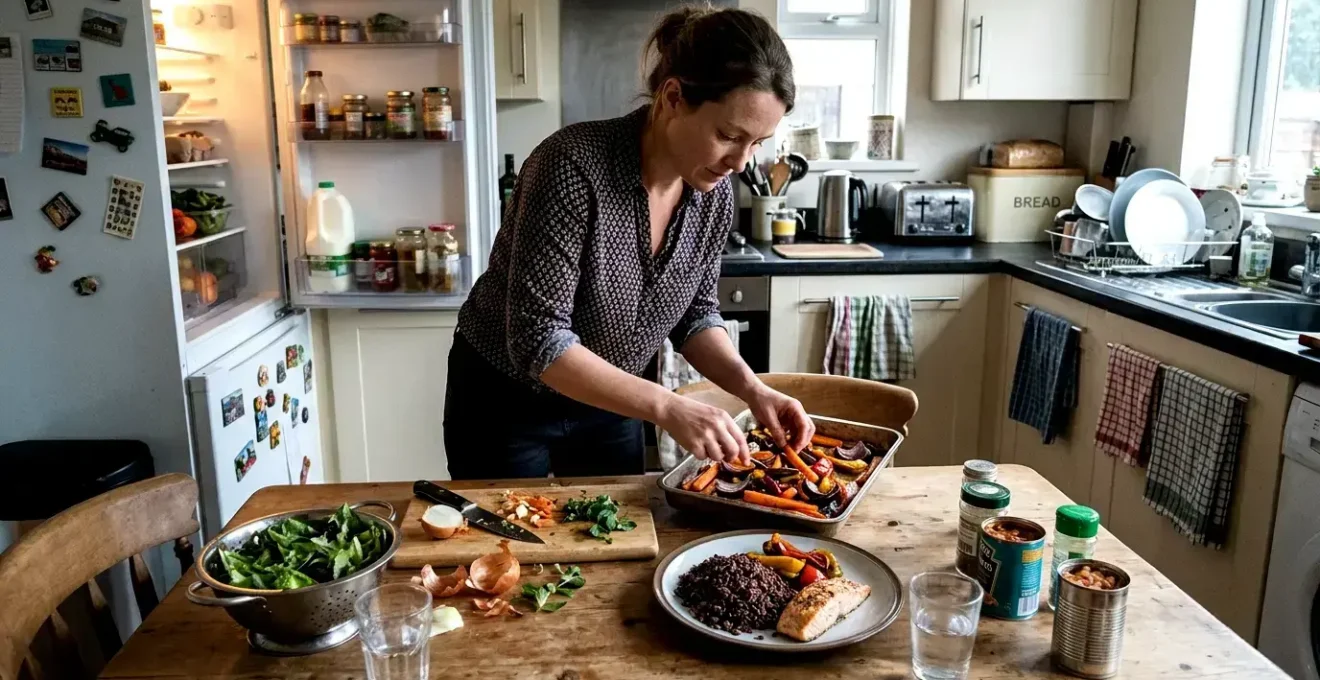
A balanced diet should work on the evening you arrive home late, the day you eat lunch at your desk and the weekend when dinner plans change unexpectedly. It should not depend on weighing every ingredient, buying specialist foods or preparing seven different meals from scratch.
The practical starting point is to include a variety of vegetables and fruit, higher-fibre starchy foods, protein sources, dairy or suitable alternatives, and modest amounts of unsaturated fats across your usual eating routine. Individual meals can look different. What matters is whether the overall pattern supplies enough variety and supports your energy needs.
For adults in England, familiar supermarket ingredients can make this straightforward: porridge oats, wholemeal bread, potatoes, frozen vegetables, eggs, beans, lentils, yoghurt and fish all have a place. The challenge is rarely finding one perfectly healthy dinner. It is building a flexible system that still functions when work, commuting and family responsibilities compete for attention.
A balanced working-week diet at a glance
- Judge your food choices across the day or week rather than demanding a perfectly balanced plate at every meal.
- Use food groups and visual portions to guide meals, adjusting amounts for appetite and physical activity instead of counting calories.
- Plan five flexible dinners, keep convenient ingredients available and improve one repeatable eating habit at a time.
- Why Does Eating a Varied Mix of Foods Matter More Than Making Every Meal Perfect?
- How Can You Build a Balanced Plate Without Weighing or Tracking Your Food?
- Which Balanced Meal Structure Works Better on Active Days and Rest Days?
- Which Food-Group Imbalances Can Leave an Otherwise Healthy Diet Falling Short?
- When Should You Change One Eating Habit at a Time Instead of Overhauling Your Diet?
- How Can You Make an Ordinary Meal More Nutrient-Dense With Three Simple Additions?
- How Can You Plan Five Dinners While Leaving Room for Schedule Changes?
- What Makes Nutrition Effective in Real Life Rather Than Only on Paper?
Why Does Eating a Varied Mix of Foods Matter More Than Making Every Meal Perfect?
Eating a varied mix of foods matters because different food groups provide different nutrients, and no single meal needs to supply everything. A balanced eating pattern develops across multiple meals rather than through strict rules at breakfast, lunch and dinner. Weekly variety makes room for busy days, social meals and occasional convenience foods.
The NHS Eatwell Guide explicitly explains that dietary balance can be achieved over a day or even a week. This means an office lunch that contains few vegetables does not automatically make the day nutritionally unsuccessful. You can include more vegetables at dinner or choose fruit with another meal.
Variety also matters within food groups. Repeating chicken, white rice and broccoli every evening might look balanced, but rotating protein sources, grains and vegetables provides a broader mix of nutrients and dietary fibres.
Research from the American Gut Project examined how consuming different plant foods relates to the gut microbiome. Participants reporting more than 30 plant types per week showed different microbial characteristics from those consuming 10 or fewer. These observational findings do not establish that 30 plants is a nutritional requirement or that reaching this number guarantees better health.
Nevertheless, the research offers an interesting optional variety challenge. Plant foods can include vegetables, fruit, beans, lentils, wholegrains, nuts, seeds, herbs and spices. Instead of focusing exclusively on whether each meal appears perfect, consider how many different types appear in your meals throughout the week.
A flexible approach sometimes gets described as an 80/20 pattern, where most choices support dietary quality while leaving room for enjoyment and convenience. That ratio is a personal planning convention, not an NHS recommendation or a scientifically established threshold.
Equally, restrictive ideas about clean eating can make normal shopping and shared meals unnecessarily difficult. Excluding entire food groups without a medical, ethical or other sound reason may reduce nutritional variety.
Once a balanced diet becomes a pattern rather than a daily test, the next step is finding a visual way to build individual meals without making food preparation complicated.
How Can You Build a Balanced Plate Without Weighing or Tracking Your Food?
You can build a balanced plate by including vegetables or fruit, a source of starchy carbohydrate and a protein food, with dairy or suitable alternatives and unsaturated fats included across the day. Use the plate as a visual reminder of food-group variety, not as a precise measurement tool or a rigid portion prescription.
The NHS Eatwell model recommends that fruit and vegetables and starchy carbohydrates each make up just over one-third of overall food intake. It also includes beans, pulses, fish, eggs, meat and other proteins, alongside dairy or alternatives and small amounts of unsaturated oils.
Those are proportions for the overall diet, not compulsory divisions for every dinner plate.
For an easy working-week illustration, you could arrange roughly a third of a plate as vegetables, around a quarter to a third as potatoes, rice or pasta, and roughly a quarter as a protein source. This is an informal visual shortcut rather than an exact reproduction of the Eatwell Guide.

You can also use your hand as an approximate reference: a palm-sized serving of a protein food, a fist-sized portion of cooked starchy food and a generous amount of vegetables may be a convenient starting arrangement. Actual needs vary, and larger or smaller portions may be appropriate.
Mixed dishes require a slightly different approach. Rather than trying to separate every ingredient into precise categories, identify what is already present and what is missing.
- Sandwich lunch: wholemeal bread and egg provide starch and protein; add salad vegetables and a piece of fruit if these are missing.
- Curry and rice: keep the familiar dish but add vegetables or lentils when the curry contains little plant food.
- Pasta dinner: combine the pasta with vegetables and a protein source, such as beans, fish or chicken.
Look beyond the main ingredients too. Cooking oils, creamy sauces, dressings and sugary drinks can contribute substantial energy without adding much food-group variety. You do not have to eliminate them, but their quantities and frequency still matter.
For most everyday meal decisions, visual portions are enough to guide sensible improvements. Measuring intake may become useful when assessing specific nutritional requirements or managing a health condition, ideally with appropriate professional advice.
A visual template simplifies food choices, but it should also accommodate the difference between a quiet desk day and a physically demanding one.
Which Balanced Meal Structure Works Better on Active Days and Rest Days?
On active days, a balanced meal structure may include more carbohydrate-rich foods and additional food around demanding activities. On quieter days, you may naturally need less overall energy, but protein, vegetables and other essential food groups remain important. The aim is to adjust portions to activity and appetite without turning rest days into restrictive eating days.
A day spent walking between appointments, working physically or exercising after work can create different energy needs from a day spent mainly sitting. Carbohydrates from foods such as potatoes, oats, bread, rice and pasta provide useful fuel, particularly around prolonged or demanding activity.
For an active evening, a dinner of salmon, brown rice and vegetables might need a more generous rice portion than on a quieter day. A yoghurt and banana after exercise could also be useful when you are hungry or your next meal is some time away.
There is no single portion formula that works for all active and rest days. The amount and intensity of exercise, body size, appetite and wider nutritional needs all affect what is appropriate.
On a rest day, keep the same basic food groups. You might choose a vegetable-rich lentil stew with wholemeal bread, or chicken with a baked potato and salad. Reduce a portion only if it makes sense for your appetite and overall intake.
Importantly, muscle recovery and normal body functions continue between exercise sessions. Protein does not become unnecessary simply because you are resting.
To decide whether your current approach works, pay attention to practical signals:
- Can you concentrate through the afternoon without persistent fatigue?
- Do you usually feel comfortably satisfied between meals?
- Are you unusually hungry after exercise or late in the evening?
- Does your eating pattern support recovery without leaving you feeling deprived?
These observations are useful clues rather than diagnostic tests. Persistent exhaustion, marked changes in appetite or unexplained weight changes deserve professional assessment.
Once meal quantities feel more appropriate, examining which food groups appear consistently across the week can reveal nutritional gaps that portion adjustments alone will not solve.
Which Food-Group Imbalances Can Leave an Otherwise Healthy Diet Falling Short?
A diet can contain plenty of foods marketed as healthy and still lack fibre, varied plant proteins, wholegrains or sources of long-chain omega-3 fats. These gaps often arise from repeatedly choosing the same convenient ingredients. A short food-group review can reveal what is missing without requiring calorie calculations or detailed nutrient tracking.
Fibre is a particularly relevant example in England. The NHS recommends 30 g of dietary fibre per day for adults, while reporting average intake at approximately 20 g. A breakfast cereal described as nutritious or a protein-focused lunch does not automatically provide enough fibre.
30 g per day
Recommended adult dietary fibre intake in UK guidance. The NHS reports that typical intake is lower, so choosing higher-fibre foods regularly can help close the gap.
Wholemeal bread, porridge oats, brown rice, lentils, chickpeas, vegetables and fruit can all contribute. Fibre supports normal digestion and is associated with several longer-term health benefits. Increasing it through a variety of foods also avoids depending on a single cereal or supplement.
Fish is another food group worth checking. The NHS recommends at least two portions of fish weekly, including one portion of oily fish, with a portion approximately 140 g.
Oily fish such as sardines, mackerel and salmon contain long-chain omega-3 fats. White fish such as cod and haddock provides different nutritional benefits but generally less of these fats. People who avoid fish need to consider suitable alternatives according to their dietary requirements; plant omega-3 sources are not directly interchangeable in every respect.
Some groups, particularly those who are pregnant, breastfeeding or may become pregnant, have specific fish-intake restrictions and should follow the relevant safety guidance.
Another potential imbalance is relying heavily on processed products advertised as high-protein or low-sugar while rarely eating beans, wholegrains or vegetables. A product’s marketing claim does not describe its contribution to the whole diet.
A useful review takes only a few minutes at the end of the week. Record the presence of major food groups rather than grams or calories.
| Food group | What to check | Possible next adjustment |
|---|---|---|
| Fruit and vegetables | Were different varieties included regularly? | Add a different vegetable to familiar dinners. |
| Wholegrains | How often did you choose higher-fibre starches? | Swap some white bread, rice or pasta for wholegrain versions. |
| Beans and pulses | Did lentils, chickpeas or beans feature? | Add a tin of pulses to a curry or chilli. |
| Fish | Were fish meals included, including oily fish where appropriate? | Plan a suitable fish meal or review dietary alternatives. |
| Protein variety | Did you rely on the same protein every day? | Rotate between eggs, beans, fish, meat or suitable substitutes. |
The purpose is to notice recurring omissions, not to score every choice. Correcting a gap by eating one particular food daily can simply introduce another variety problem.
When you know which food group needs attention, a targeted habit is usually easier to maintain than replacing your entire diet at once.
When Should You Change One Eating Habit at a Time Instead of Overhauling Your Diet?
Changing one eating habit at a time is particularly useful when work is demanding, existing routines are deeply established or previous complete diet overhauls have proved difficult to maintain. A broader change may feel easier during a natural routine transition, but gradual adjustments make it simpler to identify what genuinely improves everyday eating.
Consider someone who regularly finishes work late and relies on ready meals. Replacing every dinner with a new recipe, preparing all lunches from scratch and changing breakfast simultaneously creates several additional tasks.
A smaller improvement would be to keep frozen vegetables available and add them to the usual evening meal. The existing dinner routine becomes a reminder for the new behaviour, reducing the need for a separate decision.
This approach is often called habit stacking: attaching an intended action to something that already happens regularly.
Other practical examples include placing fruit in your work bag when preparing your keys, adding beans when opening a tin of tomatoes for chilli, or choosing wholemeal bread during your ordinary supermarket shop.
There are situations where a more comprehensive reset is sensible. Moving house, changing jobs or rearranging commuting patterns can disrupt previous routines and create an opportunity to reorganise shopping and meal preparation. Even then, the new arrangements should remain achievable once ordinary work pressures return.
The comparison below helps determine which approach suits your circumstances.
| Consideration | One habit at a time | Broader routine reset |
|---|---|---|
| Best circumstances | Busy periods and established routines | Major changes to household or work schedules |
| Preparation needed | One ingredient, swap or repeated action | Shopping, meal timing and kitchen organisation |
| Main advantage | Easier to identify which change helps | Several connected routines can be redesigned |
| Main risk | Progress may feel gradual | Too many demands may be difficult to sustain |
A useful habit also needs a minimum version for difficult days. If your intention is to eat more vegetables, adding a handful of frozen peas to dinner still counts as practising the behaviour when you have little time.
Measure success through repetition in ordinary circumstances, not through an uninterrupted streak. Once a change feels familiar, you can decide whether another improvement would be helpful.
Small habits become especially effective when they improve foods you already enjoy, rather than requiring completely different meals.
How Can You Make an Ordinary Meal More Nutrient-Dense With Three Simple Additions?
You can make a familiar meal more nutrient-dense by adding a vegetable, including beans, lentils, nuts or seeds where suitable, and choosing a higher-fibre wholegrain when practical. These changes can improve the range of nutrients and fibre in your meals without requiring a different recipe, specialist ingredients or an elaborate cooking session.
Think of this as a flexible three-addition framework rather than a rule that every dish needs three extra ingredients. The objective is to improve the meal’s nutritional contribution while keeping preparation realistic.
The first addition is a vegetable or salad item. Frozen spinach, peas, broccoli, mixed peppers or a bag of pre-washed salad can work with many everyday meals.
The second is a pulse, nut or seed element. Lentils and beans can contribute fibre and plant protein, while nuts and seeds provide additional nutrients and fats. Their amounts should suit the dish and your needs.
The third is a wholegrain swap. Brown rice, wholewheat pasta and wholemeal bread often increase fibre compared with their refined equivalents.
These changes may add energy as well as nutrients, so additions do not automatically make a meal lower in calories. When portions already feel sufficient, swapping ingredients can be more suitable than continuously adding food.
Here is how the framework can work with familiar supermarket meals:
- Shop-bought curry: stir in frozen spinach and a few spoonfuls of cooked lentils, then serve with brown rice if convenient.
- Tomato pasta: add tinned cannellini beans, prepare a simple side salad and choose wholewheat pasta.
- Weekday chilli: include mixed peppers and kidney beans, then serve with brown rice or another preferred higher-fibre starch.
Fresh ingredients are not essential to this method. Frozen vegetables, drained tinned pulses and pre-washed salads reduce preparation demands and make nutritious choices possible on evenings when you do not want to cook extensively.
A single ingredient can also serve several purposes. Chickpeas contribute protein and fibre, while vegetables add fibre alongside vitamins and other nutrients. Combining several food groups is often more useful than searching for a particular superfood.
Convenient fortified foods may have a role in some diets, but they are not a substitute for considering overall food-group variety.
Once familiar meals are easier to improve, the remaining challenge is organising ingredients across a week without becoming trapped by a rigid dinner calendar.
How Can You Plan Five Dinners While Leaving Room for Schedule Changes?
Plan five flexible dinner ideas rather than assigning a fixed recipe to every weekday. Choose meals that share ingredients, prioritise highly perishable foods early and include options based on frozen or cupboard ingredients. Keep two easy backup dinners available so a late meeting or unexpected invitation does not disrupt the entire week’s food routine.
A rigid Monday-to-Friday menu assumes that work finishes predictably and everyone is ready to eat at the expected time. In reality, a train delay, appointment or evening out can leave an elaborate recipe unused.
A pool of meals gives you alternatives without requiring a fresh decision every night. The following is an illustrative plan, not a prescribed menu.
| Dinner concept | Core ingredients | When it fits best |
|---|---|---|
| Salmon, potatoes and greens | Fresh salmon, potatoes, broccoli | Early in the week when fresh fish is ready to use |
| Chicken and vegetable wraps | Chicken, wholemeal wraps, salad | When fresh salad ingredients are available |
| Lentil and tomato pasta | Wholewheat pasta, tinned lentils, tomatoes | Any evening with limited preparation time |
| Bean and pepper chilli | Beans, peppers, tomatoes, brown rice | When batch cooking is convenient |
| Vegetable and egg fried rice | Eggs, frozen vegetables, safely stored cooked rice | A flexible late-week option |
Arrange ingredients according to storage requirements rather than assuming every item will remain fresh all week. Fresh fish and delicate salad vegetables may need earlier use or appropriate freezing, while tinned beans and frozen vegetables offer more flexibility.
For cooked rice, follow food-safety guidance: cool it quickly, refrigerate promptly and use within the recommended storage period. Refrigerated leftover rice should not be treated as an indefinitely available convenience ingredient.
Batch-friendly components make the plan more useful. A tray of roasted vegetables might accompany fish one evening and fill wraps another. Cooked lentils can be used in a tomato sauce or chilli. Preparing some components in advance reduces repeated cooking, provided storage and reheating are handled safely.

Keep two backup meals that require little preparation. An omelette with frozen vegetables and wholemeal toast, or a tinned bean and tomato stew, can replace a planned dinner without requiring another supermarket trip.
Cooking a little extra can also reduce waste when the second use is intentional. Plan which lunch or dinner will use the leftovers before increasing quantities, and freeze portions promptly when appropriate.
Build your flexible five-dinner plan in five actions
- Choose five dinner concepts. Write a short menu of five familiar meals without attaching them to particular weekdays.
- Identify shared ingredients. Make one combined shopping list and mark ingredients that appear in at least two meals.
- Check storage priorities. Label each meal as suitable for earlier use, later use or freezing according to its ingredients and storage requirements.
- Choose two backup dinners. Write down two meals you can prepare mainly from suitable cupboard or frozen ingredients.
- Assign one planned second use. Record which cooked component will become another meal, including how it will be stored safely.
A completed plan should leave you with five meal options, a realistic shopping list, a clear idea of what needs using first and alternatives for disrupted evenings. It does not need to predict exactly what you will feel like eating on Thursday.
The most useful meal plan is one that survives ordinary interruptions. That principle also provides a reliable way to judge any broader nutritional approach.
Key takeaways for making balanced eating sustainable
- Start with the food groups missing from your usual routine before investing effort in complicated nutritional details.
- Choose meal ideas and ingredients that fit your actual shopping budget, preparation time and household preferences.
- Evaluate an eating habit by whether you can repeat it during busy weeks, not just when you have spare time.
What Makes Nutrition Effective in Real Life Rather Than Only on Paper?
Nutrition becomes effective in everyday life when a dietary pattern provides appropriate nourishment and can be maintained through ordinary working weeks. A technically detailed plan offers little practical value if it repeatedly collapses under time pressure. Consistent food-group variety, flexible meals and achievable routines matter more than pursuing unnecessary precision.
Good nutrition still requires attention to nutritional adequacy. Convenience alone is not enough if meals routinely exclude important food groups. However, a complicated plan is not automatically better than a simple one built from familiar ingredients.
For many adults, the most worthwhile changes involve eating more varied vegetables and fruit, choosing higher-fibre starches, including suitable protein sources and considering the balance of foods across the week.
These basics offer a clearer starting point than searching for superfoods, insisting on exact meal timings or calculating every macronutrient. More detailed dietary planning has its place for particular medical conditions, athletic demands or other individual requirements, but it is not necessary for everyone.
Before adopting a new eating approach, test it against ordinary constraints:
- Time: Can you prepare the meals after a tiring day or using ingredients prepared earlier?
- Budget: Are the ingredients affordable through your normal supermarkets and shopping routine?
- Variety: Does the plan include different sources of fibre, protein and other nutrients?
- Flexibility: Can you accommodate meals out, takeaways and unexpected schedule changes?
- Effort: Can the approach continue without constant weighing, tracking or extensive planning?
None of these questions requires a flawless answer. They help identify why a seemingly sensible eating system might prove difficult to sustain.
Revisit the seven-day food-group audit periodically if you find it helpful. You may discover that a simple change, such as keeping tinned lentils available or switching to wholemeal bread, has become automatic. You might also notice a recurring gap that needs a different solution.
Dietary needs vary, and people with allergies, restrictive medical diets, eating disorders or other specialist requirements may need individual guidance rather than a general meal template.
Choose one ordinary meal you already eat regularly, identify one useful food-group improvement and add it to your next shopping list. Repeat the change until it fits naturally into your routine, then decide whether another adjustment would help. A balanced diet becomes easier when it is the outcome of familiar, repeatable decisions rather than a task you have to start again every Monday.
Can you follow a balanced diet if you regularly eat lunch at work?
Yes. A packed lunch, supermarket meal or workplace canteen meal can contribute to a balanced diet. Look for a combination of starchy foods, protein and vegetables or fruit, then consider what other food groups you can include later. You do not need to achieve perfect balance at lunchtime.
Do you need to eat exactly 30 different plants every week?
No. The figure comes from observational microbiome research comparing different levels of plant-food variety. It is not an official minimum nutritional requirement. Including a broader range of vegetables, fruit, legumes, wholegrains, nuts and seeds can be a useful goal, but there is no need to treat the number as a pass-or-fail target.
Can frozen and tinned foods form part of a balanced diet?
Yes. Frozen vegetables, tinned pulses, tinned fish and other suitable cupboard foods can make balanced meals easier to prepare. Compare labels where relevant, including added salt, sugar and sauces, and choose options that complement the rest of your diet. Fresh ingredients are useful but are not mandatory for every meal.
Is it necessary to eat three meals every day?
Three meals can provide a convenient structure, but a fixed meal frequency is not essential for every adult. What matters is whether your overall eating pattern meets your nutritional needs and supports comfortable energy levels and appetite. People with medical conditions or specific dietary requirements may need more structured advice.
Can a takeaway fit into a healthy weekly eating pattern?
Yes. An occasional takeaway does not determine the nutritional quality of your whole diet. Consider the meal’s ingredients, portions and frequency, and balance your wider food choices with varied vegetables, higher-fibre carbohydrates and appropriate protein sources. There is no need to compensate for an enjoyable meal through unnecessary restriction the following day.