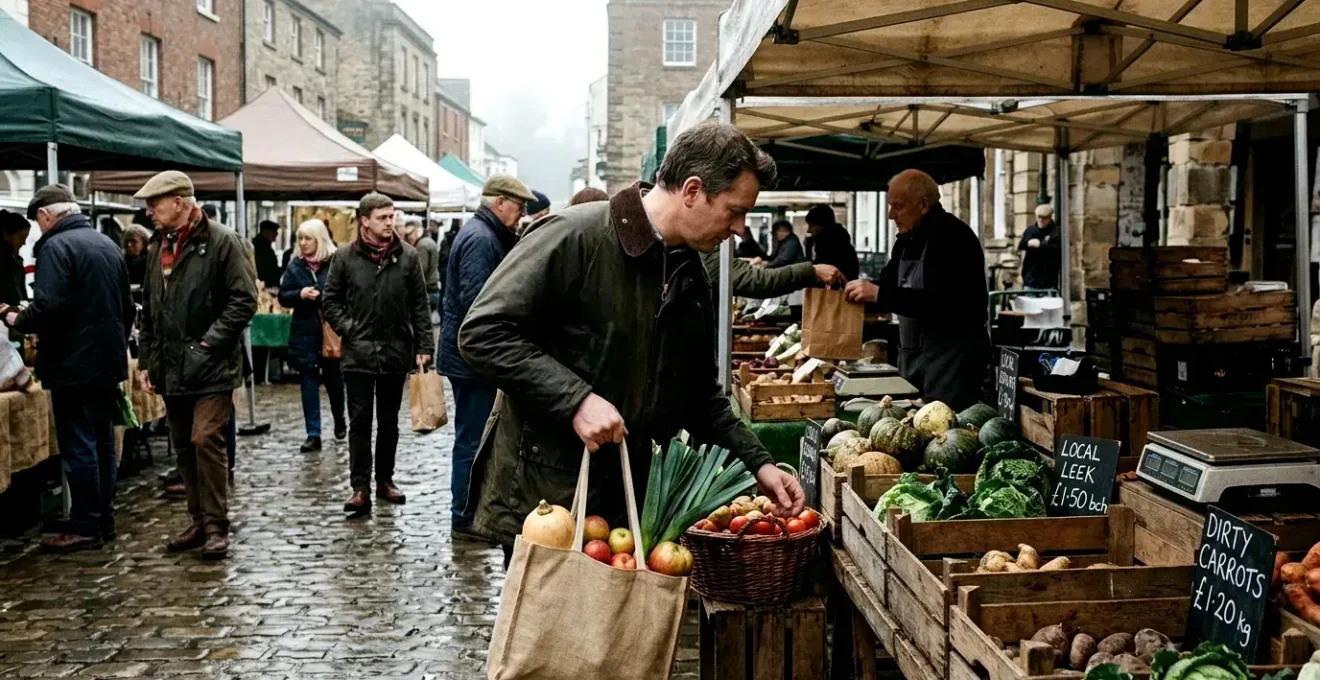
A farmers’ market can be a brilliant place to discover English seasonal produce, from tender spring asparagus to autumn squashes and unfamiliar varieties of apples. Yet colourful stalls, enticing samples and generous bunches can make it surprisingly easy to spend more than intended or return home with vegetables that never reach the dinner table.
The trick is to shop with a flexible plan rather than an unlimited appetite for discovery. Check what is already in your kitchen, decide how many fresh ingredients your household can realistically use, and compare stalls before buying. You do not need to replace your supermarket shop or master dozens of new recipes.
Market shopping works particularly well when it complements an ordinary weekly routine. A few carefully chosen seasonal ingredients can bring fresh flavours to familiar dishes, while supermarkets continue supplying everyday essentials. The aim is not to buy the most interesting produce on display, but to choose food that fits your budget, cooking habits and available time.
Farmers’ market shopping in brief
- Make one circuit of the market before buying, comparing prices per kilogram, quality and realistic quantities.
- Buy a few seasonal ingredients for meals you already know how to cook, while keeping supermarket staples on your usual list.
- Plan when each fresh item will be eaten, stored or frozen before paying, especially when considering bulk offers and reductions.
- Why Can a Farmers’ Market Offer More Seasonal Variety Than Your Usual Food Shop?
- How Can You Shop a Farmers’ Market When You Do Not Know What Will Be Available?
- Farmers’ Market or Supermarket: Which Is Better for Different Parts of Your Weekly Shop?
- Which Farmers’ Market Buying Mistakes Can Leave You With Too Much Fresh Produce?
- When Is the Best Time to Visit a Farmers’ Market for Choice or Better-Value Produce?
- Why Can Eating With the Seasons Make Weekly Cooking Feel Less Repetitive?
- Which Meal-Planning Mistakes Lead to Unused Ingredients by the Weekend?
- How Can Seasonal Produce Make Everyday British Meals More Varied and Practical?
Why Can a Farmers’ Market Offer More Seasonal Variety Than Your Usual Food Shop?
A farmers’ market can offer more seasonal variety because growers may sell crops harvested locally, including short-season varieties and produce that does not fit the standard sizes or appearance commonly found in supermarkets. Instead of offering the same selection throughout the year, stalls can change with harvest conditions, revealing what is growing nearby and when it is ready.
Supermarkets need dependable supplies, consistent grading and products capable of travelling through distribution networks. These requirements often favour familiar commercial varieties. Growers selling directly may have more freedom to offer unusual tomatoes, different apple cultivars or vegetables harvested at stages that suit particular recipes.
That does not mean every market has a wider overall selection than a large supermarket. The difference is often in the varieties and seasonal character of individual crops, rather than the total number of products available.
London Farmers’ Markets frequently asked questions describes changing supplies of British-grown produce, including spring rhubarb, strawberries from May, cherries in July and fresh apples from August. The operator also describes producers picking vegetables and salad crops shortly before market day. These are examples from its own markets, not guarantees about every stall in England.
Learning to read the displays can be more useful than looking for a fixed shopping list:
- Large displays: Several crates of the same vegetable may indicate plentiful supply. Ask whether the crop is at its seasonal peak.
- Small, unfamiliar batches: These may be limited harvests or specialist varieties worth asking about before purchasing.
- Different sizes or maturity stages: Young leaves may suit salads, while mature greens work better in cooked dishes. Availability depends on the grower.
- Recurring favourites: Noticing which items return across visits helps establish a practical local harvest calendar.
For example, young beetroot with its leaves attached offers different cooking possibilities from large, mature roots. The smaller roots can be roasted whole, while larger ones may be better suited to soups or slow roasting. This variation can make the same crop useful in several dishes.
Because a stall’s contents depend on weather, region and harvesting decisions, particular varieties may appear briefly or not at all. Treat that uncertainty as a reason to stay flexible rather than a reason to buy everything unusual.
The next step is to turn this changing supply into a shopping method that works even when you cannot predict exactly what the growers will bring.
How Can You Shop a Farmers’ Market When You Do Not Know What Will Be Available?
Shop an unfamiliar farmers’ market with a short list of meal requirements rather than a rigid list of vegetables. Choose two or three dependable ingredients as anchors, leave room for one or two seasonal discoveries, and walk around every stall before purchasing. This approach allows you to compare options while keeping your food budget and weekly meals under control.
Start at home. If potatoes, onions and eggs are already in the cupboard or fridge, there is no need to buy more simply because a stall has an attractive display. Instead, decide what is missing: perhaps vegetables for a roast, greens for two evening meals or fruit for breakfasts.
A useful approach is to make two passes around the market.
- On the first circuit, look at prices, portions, quality and seasonal availability without buying anything.
- Identify stalls selling ingredients that suit your planned meals, noting the price per kilogram where possible.
- On the second circuit, purchase only what fits your meal requirements and remaining budget.
Suppose you intended to buy spinach, but a stall has fresh chard at a more attractive price. If you planned to sauté the spinach with garlic, chard may work as a straightforward substitute. If you were making a raw spinach salad, however, you would need to reconsider the dish rather than assume the substitution is identical.
Before visiting, consult the British Dietetic Association‘s UK seasonal fruit and vegetable calendar. Its monthly lists offer a helpful indication of what might be available. For example, May includes asparagus, peas and spinach, while November includes leeks, parsnips, pumpkin and winter squash.
Use the calendar to make three informal categories: likely to find, worth looking for, and unlikely at this time of year. Actual availability still depends on local growing conditions and individual producers.
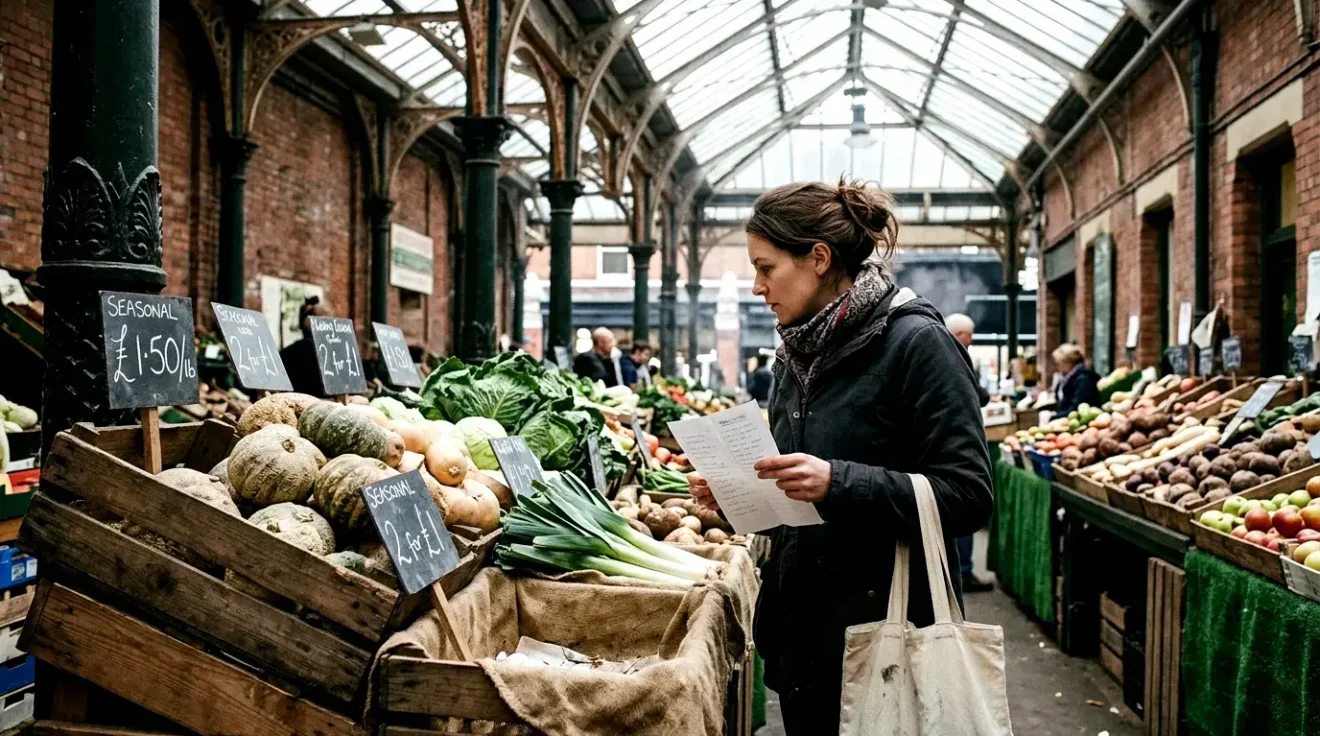
Regular visits make the uncertainty easier to manage. Ask growers which crops are approaching their peak, which vegetables are nearing the end of their season, and what they expect to bring next week. Their answers can help shape future meals without committing you to unnecessary purchases today.
Your five-step farmers’ market shopping checklist
- Check existing supplies: Write down the fresh ingredients already in your fridge, creating a short inventory.
- Count realistic meals: Note how many meals need fresh produce before your next shop, producing a clear quantity limit.
- Set a spending ceiling: Choose a market budget and record the amount on your shopping list.
- Compare before buying: Complete one full market circuit and note two or three relevant prices or portion sizes.
- Assign each purchase a purpose: Record the meal or storage plan for every perishable item before leaving the market.
Once you know how to shop without a fixed list, the bigger decision is which foods are actually worth buying at the market and which are more practical to purchase elsewhere.
Farmers’ Market or Supermarket: Which Is Better for Different Parts of Your Weekly Shop?
Farmers’ markets are particularly useful for exploring peak-season produce, specialist varieties and foods sold directly by local producers. Supermarkets usually offer greater convenience for packaged staples, frozen goods and consistent year-round availability. Neither is automatically cheaper, so a combined shopping approach often makes more practical sense than choosing one retailer for every item.
A market tomato picked at the height of its season may offer a flavour or variety you particularly enjoy, but that does not establish that it costs less than supermarket tomatoes. Equally, a generous portion of locally grown carrots may be competitively priced without making every market vegetable a bargain.
The simplest comparison is to look at what each outlet contributes to your household’s meals.
| Food category | Farmers’ market | Supermarket |
|---|---|---|
| Peak-season vegetables | Useful for local varieties and harvest-specific selections; compare prices | Useful for predictable availability and standard packs |
| Eggs | Opportunity to ask producers about sourcing and production methods | Convenient for consistent purchasing and comparing labelled options |
| Artisan bread and specialist cheese | Worth exploring for particular producers, flavours and craftsmanship | May offer more economical everyday alternatives |
| Tinned beans, rice and pasta | Availability varies; not usually the main reason to visit | Practical for routine purchases and comparing pack sizes |
| Frozen vegetables and fruit | Often outside the typical fresh-produce stall selection | Useful for longer-term meal planning and reducing reliance on fresh stock |
| Out-of-season fruit | May be unavailable at producer-focused markets | Usually offers a more consistent selection |
Price comparisons need to be specific. A 2015 Public Health Nutrition study comparing farmers’ markets and supermarkets examined fruit and vegetable availability and prices across different seasons in North Carolina, United States. It found that price competitiveness differed by product and season.
That research does not establish prices in present-day England. It does, however, illustrate why broad claims that markets are always cheaper or always more expensive are unreliable.
Before visiting, check the supermarket price per kilogram of two or three vegetables you buy regularly. At the market, compare equivalent products and consider quality, usable quantity and travel costs alongside the displayed price.
For instance, a large bunch of herbs may look like excellent value, but a smaller supermarket pack could be the better purchase if you only need a few sprigs. Conversely, a market bunch that supplies several planned meals may justify its price.
Cost per usable portion matters more than cost per bag. Freshness can be an advantage, but storage conditions, harvesting methods and product handling vary, so market produce should not automatically be assumed to last longer or spoil faster.
Travel also changes the equation. A dedicated car journey for a handful of vegetables may undermine savings, whereas a market visit combined with an existing errand may be more economical.
For many households, a modest market purchase supplemented by an ordinary supermarket shop is easier to budget for than trying to source everything from independent stalls.
Which Farmers’ Market Buying Mistakes Can Leave You With Too Much Fresh Produce?
The biggest farmers’ market buying mistakes are purchasing more than you can eat, choosing attractive produce without a meal in mind, buying the same ingredient from several stalls and overlooking what is already at home. These habits turn apparently good-value purchases into waste, particularly when delicate vegetables and ripe fruit are involved.
Bulk buying is especially tempting. A large bag of courgettes may cost less per kilogram than a small portion, but that saving disappears if half the bag goes unused. Quantity only creates value when it matches actual consumption.
Another common problem is buying ingredients for an imagined version of your week. You may picture making fresh salads every lunchtime, although your usual routine involves sandwiches, leftovers or eating away from home. The produce then sits untouched until its quality deteriorates.
Four purchasing patterns deserve particular attention:
- The bulk bargain: Buying a large quantity because the unit price is attractive, without enough meals or storage capacity to use it.
- The unplanned discovery: Choosing an unfamiliar vegetable without knowing how to prepare or serve it.
- The duplicate purchase: Buying more tomatoes, potatoes or greens from a second stall after forgetting what is already in your bag.
- The forgotten fridge: Returning home with fresh food that competes with ingredients already approaching the end of their usable life.
A sensible quantity rule starts with how quickly the food is likely to deteriorate under your storage conditions. Delicate salad leaves, herbs and ripe berries generally deserve earlier meal slots, while properly stored roots and intact winter squashes can often be scheduled later. Exact keeping times vary with the crop, its condition and the storage environment.
Rather than assuming that an unfamiliar vegetable will keep for weeks, ask the grower how best to store it and how soon they recommend using it.
Consider a hypothetical household planning four dinners that include vegetables. Buying enough fresh produce for eight elaborate vegetable dishes makes little sense unless lunches, batch cooking or freezing will absorb the extra portions.
At the other extreme, buying just enough for the meals you expect to prepare keeps the budget clearer and gives every ingredient a purpose.
End-of-day reductions require the same discipline. A discounted punnet of very ripe strawberries is only worthwhile if it can be eaten promptly or preserved appropriately. A lower price cannot compensate for food that will ultimately be discarded.
Knowing what you can use also makes it easier to decide when to visit, because the best shopping time is not necessarily the moment when the prices look lowest.
When Is the Best Time to Visit a Farmers’ Market for Choice or Better-Value Produce?
Visit a farmers’ market near opening time if your priority is choice, especially for limited seasonal crops and popular specialist products. Shopping towards closing time may occasionally reveal reductions on perishable goods, but discounts are not guaranteed. The best time depends on whether you value selection, potential savings or the ability to use what remains.
Early shoppers may find a fuller selection of seasonal fruit, vegetables, baked goods and unusual varieties. This can be useful when a particular ingredient matters to your meal plan, although growers’ delivery and restocking arrangements differ.
Remember that markets have official trading hours. Arriving early does not necessarily mean you can purchase before they open.
Late visits present a different opportunity. Some sellers may prefer to sell highly perishable stock rather than transport it home, particularly when the food will not keep until their next trading day. Others operate fixed prices throughout the session or can store their remaining goods for later sale.
Potential end-of-day offers are therefore more plausible for certain ripe or delicate items than for produce that stores well. Even then, never assume a stallholder will negotiate. Check displayed prices and ask politely whether any reductions are available.
The difference becomes clearer when comparing priorities:
- Go early for choice: Particularly useful when you want specific varieties, limited-harvest crops or a reliable selection for planned meals.
- Try later for possible offers: Most useful when your recipes can adapt to what remains and you can use perishable purchases promptly.
- Avoid bargain hunting without a plan: A reduced price is irrelevant if the food spoils before being eaten.
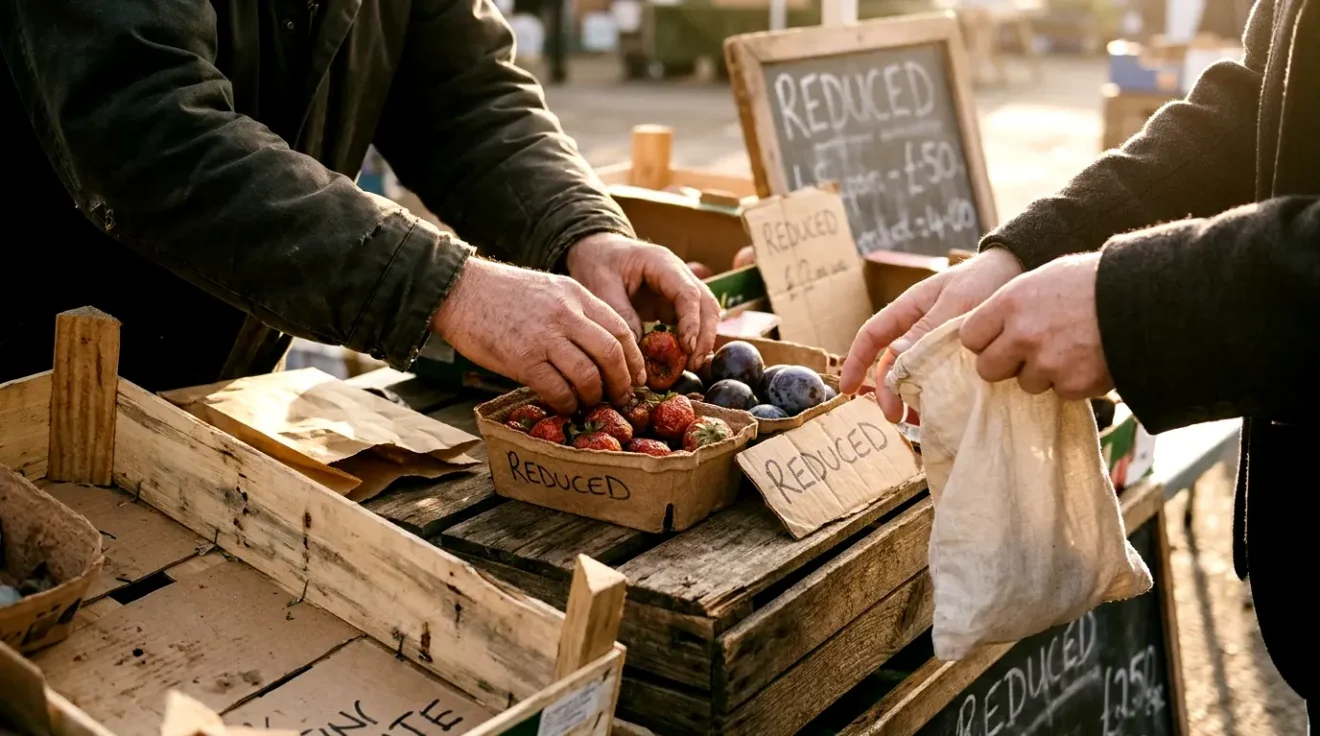
If you buy ripe fruit late in the day, decide immediately whether it will be eaten, cooked or frozen. Jam-making, compotes and fruit sauces can be useful options, but only when you have the time, suitable ingredients and appropriate food-preservation knowledge.
A practical experiment is to visit the same market early on one occasion and later on another. Keep a brief record of what you purchased, the total spent, any items you could not find and any food eventually discarded.
Repeat the comparison over a few visits if possible. This produces a more meaningful picture of your local market than relying on a universal rule about closing-time discounts. Seasonal changes and differences between trading days still need to be considered.
Once shopping becomes more deliberate, seasonal ingredients can contribute something beyond potential savings: a natural way to keep everyday cooking interesting.
Why Can Eating With the Seasons Make Weekly Cooking Feel Less Repetitive?
Eating with the seasons can make weekly cooking feel less repetitive because the ingredients available locally change throughout the year. Familiar meals can evolve without requiring entirely new recipes: spring greens replace winter roots, summer vegetables bring lighter flavours, and autumn harvests suit warming dishes. Seasonal variety becomes a simple way to refresh an established cooking routine.
Many households repeatedly buy the same small group of supermarket vegetables because they know how to prepare them. Carrots, peppers, broccoli and tomatoes may appear in similar dishes week after week, even when other British-grown ingredients are in season.
A farmers’ market introduces alternatives that fit existing recipes. Rather than learning a complicated new dish, you can make one ingredient substitution at a time.
For example:
- Replace some of the usual roasted carrots with spring radishes or seasonal greens served alongside the same main course.
- Swap a familiar vegetable in a summer pasta dish for courgettes or runner beans, adjusting cooking times as needed.
- Use autumn squash in a soup you normally make with carrots or potatoes.
- Add chopped winter leeks to a savoury pie or traybake instead of relying on the same vegetables every week.
These changes work because the cooking method stays familiar while the ingredients rotate. There is less need to buy specialist equipment, follow an unfamiliar recipe or commit to a large collection of new seasonings.
Produce harvested in season may also work well with uncomplicated preparations. Roasting, steaming and gently frying vegetables can showcase their natural character without elaborate sauces. However, seasonality alone does not guarantee better flavour or quicker cooking; freshness, variety, personal preferences and preparation methods all matter.
Start with one new ingredient per market visit. If the household already enjoys vegetable soup, choose one unfamiliar seasonal vegetable that suits soup-making. Once it becomes familiar, it can join the regular rotation.
For someone cooking after work, this gradual approach is often more practical than collecting ambitious recipes that require ingredients from several different shops.
Variety is most useful when the ingredients actually reach the plate, which makes realistic meal planning just as important as selecting appealing produce.
Which Meal-Planning Mistakes Lead to Unused Ingredients by the Weekend?
Unused ingredients often result from planning more meals than a household can realistically cook, buying produce for a single recipe, leaving no flexibility for changing schedules and failing to plan how leftovers will be used. Farmers’ market purchases are especially vulnerable when shoppers choose several fresh ingredients but do not match them to available cooking time.
A seven-day menu can look sensible on paper and still fail by Wednesday. An unexpected late finish, a family invitation or a change in appetite may mean one planned dinner never happens. Fresh ingredients assigned only to that meal are then left without a purpose.
The solution is not necessarily more detailed planning. It is to create a plan that can absorb changes without abandoning ingredients.
Begin with the meals that are genuinely likely to be cooked. Leave one flexible evening for leftovers, a freezer meal or a simple dish assembled from what remains. This prevents every ingredient from depending on an exact daily schedule.
Then reverse the usual planning process by considering what will probably be left near the end of the week. Half a bunch of parsley, a few carrots or some unused leafy greens could become part of an omelette, soup or vegetable pasta dish.
This is a leftover-led approach: instead of finding yourself with surplus food and then searching for a solution, you deliberately reserve a meal that can accommodate variable ingredients.
Ingredients with several possible uses are particularly helpful. A leek can contribute to soup, a pie filling or a traybake. A bunch of carrots can be roasted, grated into a salad or added to a stew. Buying such ingredients makes it easier to adapt when plans change.
Storage decisions should also be made as soon as the shopping comes home. Remove damaged produce, check which items require chilling and follow appropriate storage advice for each crop. Herbs, leafy greens and cut vegetables require more attention than many intact root vegetables.
The Food Standards Agency‘s official food safety guidance recommends cooling, covering and refrigerating or freezing cooked leftovers within one to two hours. Refrigerated leftovers should generally be eaten within 48 hours under that guidance. Cooked rice has stricter handling advice and should be cooled promptly, ideally within one hour, then kept refrigerated for no more than one day.
These rules concern prepared food rather than providing universal storage periods for raw vegetables. Keeping the distinction clear helps prevent attempts to reduce waste from compromising food safety.
A useful household habit is to check the fridge before the next market visit and identify which ingredients need using first. This creates a direct connection between what remains at home and what genuinely needs purchasing.
With those habits established, seasonal produce can fit into everyday British meals without making shopping or cooking more complicated.
What to keep in mind for your next market visit
- A worthwhile seasonal purchase should fit an existing meal format, even if the exact ingredient was unexpected.
- Flexible recipes are particularly valuable when harvest availability and household schedules both change.
- The simplest sustainable routine combines a selective market visit, essential supermarket purchases and a planned opportunity to use remaining ingredients.
How Can Seasonal Produce Make Everyday British Meals More Varied and Practical?
Seasonal produce makes everyday British meals more varied by changing the vegetables and fruit used in familiar dishes rather than changing the dishes themselves. Sunday roasts, soups, pies, traybakes, porridge and salads can all accommodate seasonal substitutions. A selective market shop, supported by supermarket staples and a flexible leftover meal, keeps this approach manageable throughout the year.
Traditional British cooking offers plenty of useful formats for seasonal ingredients. Root vegetables work well in winter roasts, spring greens can accompany simple weekday suppers, and summer berries can brighten porridge or desserts.
Many familiar crops also suit practical household cooking. Potatoes, carrots, cabbage, leeks and apples can feature in several meals, although their actual storage life depends on condition and storage methods.
Rather than building every week’s menu from scratch, use a seasonal substitution system. Keep the dishes your household already enjoys and change one or two ingredients as local availability shifts.
The following table provides examples rather than a fixed harvest guarantee. Growing conditions, regional differences and protected cultivation influence what is available at any particular market.
| Everyday meal | Spring | Summer | Autumn | Winter |
|---|---|---|---|---|
| Sunday roast | Spring greens or asparagus | New potatoes and courgettes | Roasted squash | Parsnips and carrots |
| Soup | Peas and spinach | Courgettes and tomatoes | Pumpkin and squash | Leeks and celeriac |
| Traybake | Radishes and spring greens | Courgettes and tomatoes | Beetroot and squash | Carrots and swede |
| Savoury pie | Spinach and spring vegetables | Courgettes and runner beans | Mushrooms and squash | Leeks and cabbage |
| Porridge topping | Rhubarb compote | Strawberries and other berries | Apples and pears | Stored apples or pears |
| Side salad | Lettuce and radishes | Tomatoes and cucumbers | Shredded cabbage and beetroot | Carrot and cabbage slaw |
These combinations can be adapted to your preferred recipes and the ingredients actually available. Some vegetables need cooking before being added to a dish, while others work raw. Tender greens also require shorter cooking times than dense roots, so substitutions should account for texture as well as flavour.
Imagine a hypothetical household visiting its local farmers’ market on a Saturday. The family already has pasta, rice, tinned beans and frozen vegetables at home. At the market, they choose leeks for a weekday soup, carrots for a roast and a small quantity of seasonal fruit for breakfasts.
They then buy any missing essentials at the supermarket. The leeks can also be used in a pie if plans change, and the remaining carrots can go into a late-week traybake. Each purchase has a primary purpose and an alternative use, reducing dependence on one rigid recipe.
That example is not a documented saving or proof that the approach always costs less. It illustrates how to organise purchases around practical meals rather than an overflowing shopping basket.
To make the routine repeatable, check your existing supplies before leaving home, set a market budget, compare stalls, and purchase only enough fresh produce for the meals you expect to prepare. Use the supermarket for dependable staples and reserve one meal to absorb ingredients left over from earlier in the week.
Over several visits, notice which seasonal foods your household enjoys, which quantities get used and which purchases repeatedly cause waste. Those observations are more useful than any universal rule about how much a market shop should cost.
For your next market trip, choose just one seasonal ingredient you do not usually buy, give it a place in a familiar meal and decide how you will use any remainder. That small experiment is enough to begin building a more varied, practical and less wasteful shopping routine.
Do you need to bring cash to a farmers’ market in England?
Payment arrangements depend on the market and individual stallholder. Some traders accept cards, while others may prefer cash. Check the market organiser’s information before visiting and consider having a suitable alternative payment method available. Bringing your own shopping bags is also useful for carrying purchases without unnecessary packaging.
Is everything sold at a farmers’ market grown locally?
Not necessarily. Producer rules and geographical requirements vary between market organisers. Some markets operate specific standards for sourcing and producer participation, while others have different arrangements. If local origin matters to you, ask where a product was grown or made and check the organiser’s published trading rules rather than relying on the market’s name alone.
Can you shop at a farmers’ market with a small household food budget?
Yes, provided purchases remain selective and prices are compared. Set a spending limit, check the supermarket prices of frequently purchased vegetables and focus on ingredients that fit meals already planned. Buying one or two seasonal items may be more economical than trying to replace an entire supermarket shop. Include travel expenses and potential food waste when assessing value.
What should you do if you buy an unfamiliar vegetable?
Ask the grower how they usually prepare it, whether it can be eaten raw and how it should be stored. Start with a small quantity and choose a familiar cooking method where suitable, such as roasting, steaming or adding it to soup. Avoid buying a large portion until you know whether your household enjoys the vegetable and can use it regularly.
How can you avoid wasting food when the market only operates once a week?
Plan earlier meals around delicate produce and use suitable longer-keeping ingredients later in the week. Store purchases according to their needs, freeze suitable foods before they deteriorate and keep frozen or cupboard staples for unexpected changes of plan. A flexible end-of-week meal, such as soup or a traybake, can help use remaining vegetables without requiring another shopping trip.